Saturday, August 01, 2026

Bike route goals

 Starting simple and short. Over time I’d like to bike these routes. Some in large chunks and others in little pieces that align with available time.

Single Trips

  1. Cottage to Ludington State Park and back. About 15 miles each way. Three hours of cycling total.

  2. Cottage to Pentwater campground (Lake MI Family Campground) and back. About 18 miles each way. Three hours of cycling. Classic out and back.

  3. MI cycling M119 from Harbor Springs to Mackinaw City: through the tunnel of trees! It’s about 45 miles and 4 hours each way. Could be an out and back or a drop-off/stage cars.

  4. Cottage to Hart and Hart to Muskegon. About 65 miles and 5 hours. Back roads from Ludington to Hart, connect to the Hart-Montague trail, and finally the Fred Meijer Berry Junction Trail to bring it home to Muskegon. Could be an out and back or a drop-off/stage cars.

  5. Little Traverse Wheelway between Charlevoix and Harbor Springs. About 26 miles and 2.5 hours of cycling around Little Traverse Bay. Could be a nice out and back with a bite in between.

  6. Beaver Island East and West Side Drives give a nice cycle around the island. Possible to do a ferry ride in the morning, ride the island and take the ferry back in the afternoon. It's about 35 miles depending on route specifics and a 3.5 hour ride.


    Multi-Day Plans

  7. Grand Rapids to Cadillac (and possibly back). From Riverside Park to Mitchell State Park it’s 94 miles and a full 8 hour day along the White Pine Trail. Good candidate for a weekend and take Friday or Monday off from work.

  8. Zeeland to Ludington cottage (and possibly back). From our friends' house to the cottage is 99.5 miles and a full day along the M35 cycling route. Good candidate for a weekend and take Friday or Monday off from work. This is basically an amalgamation of #2, 4, and a chunk of 10.

  9. MI cycling M20. From Algonac to Ludington on the west. It’s 300 miles and a few days ride.

  10. MI cycling M35. From New Buffalo to Sault St. Marie in the north. It’s 500 miles and a solid week of riding. Or a good candidate to break up into a few weekends of riding. It could be 8 chunks of 60-70 miles.

  11. MI cycling M10. From St. Ignace to Iron Mountain in the west. It’s 200 miles and a couple days ride.

Resources and Maps:

Thursday, July 30, 2026

Surprised by Hope vs Between the World and Me

Thematically, the coming of the kingdom of heaven, via the bodily resurrection in Wright's language, strongly parallels the inexorable struggle, and building of the "kingdom of black Americans" Coates describes. These kingdoms are not inevitable--they are built through struggle and the specific efforts and labors of people, fighting against the powers which abuse the purposes of God, and abuse black bodies. The world is not getting better in an evolutionary way or regressing into some apocalyptic rubble (or is it?).
Ta-Nehisi Coates is an atheist. He might appreciate the parallels literarily but likely would not be compelled by the concept of the kingdom of God. In the passage below he calls to resist "the comforting narrative of divine law" that implies "irrepressible justice"...and so does Wright. At least when it comes to our bringing the kingdom of God to earth.

Two quotes from Wright followed by one from Coates:
The point of the resurrection…is that the present bodily life is not valueless just because it will die…What you do with your body in the present matters because God has a great future in store for it…What you do in the present—by painting, preaching, singing, sewing, praying, teaching, building hospitals, digging wells, campaigning for justice, writing poems, caring for the needy, loving your neighbor as yourself—will last into God's future. These activities are not simply ways of making the present life a little less beastly, a little more bearable, until the day when we leave it behind altogether (as the hymn so mistakenly puts it…). They are part of what we may call building for God's kingdom.

What you do in the Lord is not in vain. You are not oiling the wheels of a machine that's about to roll over a cliff. You are not restoring a great painting that's shortly going to be thrown on the fire. You are not planting rosed in a garden that's about to be dug up for a building site. You are -- strange though it may seem, almost as hard to believe as the resurrection itself -- accomplishing something that will become in due course part of God's new world. Every act of love, gratitude, and kindness; every work of art or music inspired by the love of God and delight in the beauty of his creation; every minute spent teaching a severely handicapped child to read or to walk; every act of care and nurture, of comfort and support, for one’s fellow human beings and for that matter one’s fellow nonhuman creatures; and of course every prayer, all Spirit-led teaching, every deed that spreads the gospel, builds up the church, embraces and embodies holiness rather than corruption, and makes the name of Jesus honored in the world—all of this will find its way, through the resurrecting power of God, into the new creation that God will one day make. That is the logic of the mission of God. God’s recreation of his wonderful world, which began with the resurrection of Jesus and continues mysteriously as God’s people live in the risen Christ and in the power of his Spirit, means that what we do in Christ and by the Spirit in the present is not wasted. It will last all the way into God’s new world. In fact, it will be enhanced there.
N.T. Wright, Surprised by Hope

You must resist the common urge toward the comforting narrative of divine law, toward fairy tales that imply some irrepressible justice. The enslaved were not bricks in your road, and their lives were not chapters in your redemptive history. They were people turned to fuel for the American machine. Enslavement was not destined to end, and it is wrong to claim our present circumstance--no matter how improved--as the redemption for the lives of people who never asked for the posthumous, untouchable glory of dying for their children.
Ta-Nehisi Coates, Between the World and Me

I originally wrote this in FEB2017 after reading both books. Today I found the draft, wrote the second paragraph, and inserted the Wright quotes that I'd been holding as a placeholder.

Monday, July 27, 2026

Journey to becoming professional

 In college I first learned about who an engineer is and what they do and I also started learning about what it means to be a professional engineer.

My professor Wayne Wentzheimer shared that when he started working at ARCO Chemical after he completed his Ph.D. in 1969, it was made a requirement within the company that he and some of his colleagues become licensed. Unfortunately, I've forgotten why.

The F.E. had started being administered nationally in 1965 and had become a standardized machine-graded test in 1970 (NCEES had been founded in 1920 and Pennsylvania licensing board in 1921). The chemical P.E. was first offered in 1966. The process to become licensed in a standardized fashion was nascent but becoming more uniform. I believe he would have had both F.E. and P.E. standard tests available to him for licensing at the time in Pennsylvania - he took both in direct succession.

So, to me very early on in my education, the P.E. license became a kind of implicit requirement toward becoming an engineer. At the same time, I understood the context that the P.E. was a license typically more vital for civil and mechanical engineering careers due to their proximity to public works and the building design trade. It was an impractical achievement on the road to doing meaningful engineering work as a chemical engineer but also embedded in my perception of what it meant to be a competent and accomplished engineer. I didn't need it to do interesting work, but I wanted it to feel like I was a "real" engineer.

With that backdrop, I opted to take the Fundamentals of Engineering exam during the fall of my senior year mostly as a contingency option (you never know...what if?). We had a mini review bootcamp that was optional to attend in the evenings, which was very helpful. I then joined other students and professionals in the DeVos Place sitting at tables all day, silently pecking at calculators and filling in bubbles. The Calvin engineering education schedule had the controls class in the spring of the senior year, but other than that area, I felt well-prepared and was able to pass the exam (2010). And that's kind of where I left it - an engineer in training (E.I.T.) without much direct intention or need to move further.

My first job after graduate school was selling chemicals and doing engineering analyses for customers in support of selling chemicals (2014-2018). I didn't have any professional engineers at hand to oversee my work, and it didn't feel like it made much sense to find a P.E. to oversee and referee what I was doing. I was also under the mistaken impression that a non-P.E. was able to referee and direct qualifying experience.

Then I found work at a chemical company and the site director was licensed and could actually review and direct my work. It was also true of an eventual Disher colleague who is a P.E. and able to help me build qualifying experience. While at the chemical company I didn't really feel like I had the time to study and prepare for the P.E. test but was at least developing meaningful and significant experience in process engineering work at a chemical manufacturer.

Finally, when I left the chemical company to join Disher, I had what felt like the right time- and energy-balance (intentional pun) to actively pursue "the test". And I was also working at a food manufacturer doing qualifying project engineering work reviewed by my colleague. Ultimately, I started studying for a little over a year, a few hours per week, by taking and reviewing and re-taking the practice test published by NCEES. With trepidation and the strength-of-will from paying $400 in January (and not wanting to lose it), I set aside a day and took the test at the Grand Rapids 28th Street Pearson center - and I passed! What a relief and delight.

From there it was an administrative application to the State of MI with the right paperwork to get my license. After all the buildup of studying over the last year in earnest and long-term percolation in my head since I was a college student it was done in a very anti-climactic fashion.

My work mentioned it during an all-staff meeting and that's the end of this chapter (2010 - 2026!). What begins now is deciding if and how to use this license. And ultimately that's great.

I had built up the attainment of the P.E. license to be something it wasn't. It's not a pinnacle of achievement. It's really the minimum standard to work as the engineer of record on projects that impact the safety of the public in some fashion. It's a significant achievement, but it also demonstrates minimum competency and that was really good to realize and develop perspective around.

Wednesday, July 22, 2026

2026: the year of racing

When Paula and I were talking about what 2026 was going to look like for our family I mentioned I was interested in entering some running races. My running has been very consistent since March 2025 due to running over lunchtime with colleagues (making up the hours at night when Anja is in bed), giving me a solid aerobic base to work from. The consistency is different than how I've trained for races in the past - it was usually a sort of 3-4 month effort culminating in a race, then nothing until the next time. Over the last year or so I've felt consistently race-ready, at least for my modest fitness.

So of course, Paula suggests 1 race per month and ups the ante immediately!

We decide to do it. It takes two.

Race 1 (Jan) - Detroit Auto Show 5K

Paula, Dad Manni, and I schlep down to Detroit, leaving Anja with Mom Manni in Canton. My goal is to get close to or under 22 minutes. It's been since 2020 that I've attempted an all-out effort in the 5K and this is the year I believe I can do it. The weather is cold, blowy, and snowy and the course pavement has not been fully plowed. But I gutted it out and did 22:16.33! This is a race in January and the field reflects it - I place 1st in my age group and am feeling good that I'll get under 22 minutes this year.

Race 2 (Feb) - Zeeland Couple Shuffle 5K

Paula, Anja, and I head to Helder Park on the coldest February morning of the year (-15F). We are BUNDLED and the finish line snacks are FROZEN - waters are ice and tangerines are icegerines. The course is not cleared and I immediately note this will not be a PB. We take off and I'm in the front of the race. I look back to let people pass me on the single track made by people's footprints from walking in the foot-deep snow. No one is interested. So, I quickly but gingerly run along this path, not breaking my ankles, until the path opens up and is paved for the second half of the course. No one passes me. No one is close. I hold on and continue to not break my ankles and win the dang race in 23:50! I have no business winning races. But again, the field on a frigid February Sunday morning is small.

Race 3 (Mar) - 5K Green Run - Riverbend Park

Anja and I are in Florida visiting my parents, so Dad takes me down to Jupiter leaving Anja with Mom back at Nettles Island. It's a solid hour drive down so an early morning to get there for the 7:30am start. I'm a little nervous but think under 22 is on the table. I've started to come down with a cough, but my lungs feel pretty solid. Definitely up in the air but I decide to go for it. My mile splits are 6:57, 7:00, 7:00, and 6:20 for the last 0.1K. An older guy - ultra runner - pulls me through the whole race. I just spend time chasing him, hang on, and pass him just before the end (with his blessing). And in turn, I'm passed by the guy who had apparently been chasing/stalking me - but he's in my age group and edges me by 0.99 seconds! Either way I'm stoked to get second in the age group and finally get under 22 minutes (21:42.61)!!!!!

Race 4 (Apr) - Barry Roubaix 36 mile Thriller

The dirty gravel bike race! And I didn't really train on bikes other than doing some mountain biking during spring break in Bentonville. So, understand that my butt was HURTING by the end of it. I was standing up during every downhill. This race was fun! I went down to Hastings with Jonathan and Eric, and we had a nice morning. It was wet enough to keep the sand firm but not too wet to make the roads treacherous. BRX26 also answered the question: how well does running fitness convert to cycling? Not very well. My lungs weren't super challenged but the power from my legs was lacking. Good to learn. It was a solid effort but very middle of the pack result (2:34:29). Very happy with that for my first cycling race.

Race 5 (May) - Tulip Time 10K

Trying to build on a fun 10K last year with my brother in Kalamazoo my goal was to pace under 7:30/mi. It was a chilly morning - in the 30s F. So actually, pretty perfect for a race. Nothing fancy, just nailed each 3.1mi lap at 7:19/mi and had a nice race (45:22.72). Just off the podium but felt good the whole race. It was a nice test to see where I was at. Podium is definitely within reach.

Race 6a & 6b (Jun) - Grand Explorers 5K and Zeeland Zoom 5K

Ran each of these with our friends and their kids. We each ran with a kid - I was lucky to chaperone A to victory! In the GE5K we took third in the podium for the girls U14 and in the ZZ5K we took first in the podium for the girls U9! Super fun and really well-run races to enjoy at a more comfortable pace. Especially fun to see a young runner smoke the races out of the park!

Race 7 (Jul) - the Cross Country Team Challenge 5K - Richmond Park

Before: running a coed team race tonight! Some racers on our team are already down for the count (Kuba is SICK) and it's going to be warm. Excited. Hopefully my day of loose stool yesterday won't harm my attempt to PB.

After: it was a tough one with a strong field. I hadn't run on grass before and the hill was BIG. So didn't get the PR but ran a decent 22:22.6 (pace 7:12/mi). Very fun to run with our group. Andrew and I set out together, but he outpaced me pretty quickly. I caught back up a bit over the hill. No impacts felt from the "day of loose stool". I will need to build in some speed work and hills if I want to get back under 22 minutes. No big deal.

 Race 8 (Aug) - TBD

We're having a baby, so we'll see what actually happens. Maybe the Hudsonville Fair 5K.

Race 9 (Sep) - TBD


Race 10 (Oct) - TBD


Race 11 (Nov) - TBD

Likely the Zeeland Turkey Trot.

Race 12 (Dec) - TBD


Racing season thoughts:

Looking to make some changes for 2027. I don't feel the need to do a race each month but do want to pick some fun ones and do a little more structured preparation for them.

1. Winter 5K, Jan-Mar: 1 race for the chance to run hard without doing too much prep. Enjoy the light field coming out of winter.

2. Barry Roubaix bike race, Apr: spend some time in the winter building power in my legs and trying to match my cardio capabilities with my legs and see if I can move up from the middle of the pack with some more time in the seat and using the new power meter on the trainer in my shop.

3. Tulip Time or other May 5K: build some speed in while it's still cool and nice weather to run.

4. Summer months, Jun-Aug: run races with kids or just for fun if they come up. Don't worry about speed.

5. Oct race (5K, 10K, or half marathon): start building some speed as the weather cools and run hard in October. Preference toward half marathon.

6. Turkey Trot, Nov: most likely Zeeland. Do some intervals and hills to prepare.

7. Enjoy the winter training block.

Monday, July 13, 2026

Training with a power meter

 I love fitness data. It motivates me.

Arguably, having a Forerunner 45 watch got me into running and kept me running. I still love to pore over the stats after each run over 6 years later - now on my Forerunner 745 - 3 to 4 times per week. During each run I set an internal, nebulous pace/strain level and go mostly by feel. Afterwards the data gives me the immediate feedback of how my heartrate and pace baseline changes over time, with the weather, periods of more/less training, and in the moment of each individual run. It helps me gauge how my body feels compared to measured data from the watch that I can review over time. The 7-day load range also keeps me honest as a bulk measure of my weekly effort and I LOVE to keep in the green.

For cycling, the 45/745 are also great tools especially when coupled with a cadence and speed sensor (more for indoor riding on the trainer), but to really dive in deeply and train with more purpose and direction you're talking about adding a power meter to your bag of tools.

Recently I received a power meter for Father's Day - the Favero Assioma MX-1 (left pedal only; a very affordable and quality piece of equipment - but still close to $450 with tariff and charger). It was great fun to take it out last week on a short ride at a very simple but fun local 2-mi MTB trail. But reviewing that kind of data, devoid of context and baseline really isn't why I wanted this thing.

I pedaled my first bike race this spring - the Barry Roubaix (BRX) 2026 36mi course in April. It was an interesting test to see how running fitness would translate to cycling fitness, not having spent much time training on the bike. My main discovery was that my cardiovascular fitness was far greater than what the muscles in my legs were able to harness to deliver speed (and power):

In the BRX race I placed 776/1796 overall (top 43%) and 70/147 M34-38 (top 48%) - definition of middle of the pack.

In 2026 spring (Mar-May) running races I'm closer to top 7%/14% (overall/age group) in 10km and 3%/14-22% (overall/age group) in 5km. Based on 750 miles running since August 2025 compared to 220 miles cycling.

That's where power data comes in - establishing an intuitive baseline for cycling efforts that connects to my heartrate and the feel of my muscles. And then improve my baseline over time!

I didn't really want to add more bulky, expensive, one-use equipment to the household. And I'm very happy to do some mental work and create a less sophisticated training system than pay the big bucks for a complex machine when I can get 80% of the way there in a cruder fashion:

  1. 1. Buy a power meter to swap between my bikes: MTB, gravel/road, and the simple+cheap resistance trainer that I already have (CycleOps Fluid2).

  2. 2. Start using the power meter on rides and just review the data afterwards - just for curiosity.

  3. 3. Build a series of power curves on the trainer - cadence and gearing vs power!

  4. 4. Use the power curves to train at different power thresholds for short/long periods to improve my baseline fitness and understand how that power feels to my muscles and cardiovascular system. Be my own personal Peloton/Wahoo/smart trainer control.
So far #1 and 2 have been the easy part. You just need to have the right hex keys, wrenches, and grease to smoothly swap the MX-1 pedal between bikes (I'm using a torque wrench to protect the pedal installation too, because I already had one for my car's oil drain plug).

I have the trainer set up the shop - just need to make the time to inflate tires to a consistent pressure and get pedaling to generate the baseline.

Initial plan for gathering data:
  1. 1. Gear configuration (input)
  2. 2. Cadence (60, 80, 100 rpm; input)
  3. 3. Tire pressure (90 psi every time; assumption)
  4. 4. 5-minute average power (primary output - function of the equipment setup)
  5. 5. 5-minute average heartrate (secondary output - changes with fitness)
  6. 6. 5-minute maximum heartrate (tertiary output - changes with fitness)
Parts 1-4 create the curves and parts 5-6 track fitness over time.

And as a final nerding out - compare to the Fluid2 published curves:

https://www.cycle-ops.com/graph.jpg


https://www.timslife.com/imgsbike/trainer/cyfl2ch2.jpg

 More to come!

Wednesday, July 01, 2026

Fitness equipment prioritization

 I really love gear. But I get way too into it and find it easy to lose the thread and actually get out there to enjoy the bike or run.

Realistically you need 1. a pair of good shoes (running and cycling), 2. a bike that you like to ride with comfortable helmet, and 3. the time set aside to run and cycle safely.

From there, my prioritization goes in tiers. And my ownership is in bold.

A - Basic clothes

  1. Clothes to make running comfortable
    1. Shorts
    2. Jogger pants
    3. Short and long-sleeve shirts that wick moisture
    4. Socks that wick moisture
    5. Gloves and ear warmers
    6. Cold weather layers
    7. Belt for water and food (10+ miles / 16+ km)

  2. Clothes to make cycling comfortable
    1. Water bottles and holders
    2. Socks that wick moisture
    3. Basic tools and spares
    4. Warm weather bib / shorts
    5. Warm weather shirt with back pockets
    6. Gloves and ear warmers
    7. Warm jacket
    8. Cold weather bib / pants

B - Basic data and safety for cycling
  1. Running watch that can measure heart rate and pair with cycling sensors
  2. Front and rear lights for cycling
  3. Hydration pack for cycling
  4. Advanced tools and spares for cycling repair
  5. Bell
  6. Speed and cadence sensors for cycling
  7. Smart phone holder - careful how you use this as it could damage your phone. A cycling computer will be hardier and likely a cheaper investment compared to breaking your phone.
C - Advanced data and safety for cycling
  1. Power meter for cycling pedals (simplex) - Favero Assioma PRO MX-1, $500
  2. Heart rate monitor (improved accuracy and dynamics) - Garmin HRM-Pro Plus, $129.99
  3. Cycling computer / bike radar - Garmin Edge ####, $200-700
  4. Bike radar / cycling computer - Garmin Varia ####, $100-400
  5. Power meter for cycling pedals (duplex upgrade) - Favero Assioma PRO MX-1 upgrade, $500
  6. Power meter for cycling pedals (duplex outright) - Favero Assioma PRO MX-2, $850

Monday, April 03, 2023

Book review - Sex, Gender, and Engineering: Harassment at Work and in School

 Amazon Review: Thorough coverage and filled with first-hand accounts - 

This tremendous and comprehensive text breaks down the language and impacts of sexual harassment in a meaningful and digestible fashion. Van Antwerp and Wilson delve into what's known about sexual and gender harassment from the literature and point out where work has yet to be done. The book is widely researched including both academic and workplace data and makes helpful distinctions between the two. For those of us who have not studied this area closely, they describe and modify several classic models including learning transfer, stress, and sexual harassment as it pertains to job satisfaction & its antecedents and impacts. This book is invaluable to me as an at-times college instructor and full-time manager of engineers - the differing landscapes are well characterized.

Finally this work attends to solutions and the future in very practical ways. The authors dig into effective learning transfer strategies, different training methodologies and approaches, and expound on the nature and value of bystander training and activism within the specific context of heavily systemized engineering spaces.

I have come away with discussions and ideas to implement with my team, concepts and training improvements to discuss with site leadership, and a better understanding of the importance of cultivating a culture that engenders solidarity with all workers - even a better understanding of my workplace.

Saturday, June 20, 2020

The stress tensor

It's a tricky bit of business--something I (shamefully) never fully understood in graduate school. That always bothered me.

Continuum mechanics is wonderful. There, I said it, and now we can move on.

Ok, so the stress tensor.

It is like a vector, but not really. It's bigger than that. In reality, a scalar (such as temperature) is a zeroth order tensor. It only has a value. You can still have scalar fields (temperatures at given points), but they don't have direction. They just are, in the place where they are.

A vector on the other hand, like wind velocity, has direction and a magnitude (size or length) at some location. Therefore wind velocity can be described as a vector field. At each point you have a direction and magnitude (length) of velocity--speed is the magnitude of the velocity vector (how long it is, regardless of direction). A vector is a first order tensor.

Tensors (they can be anything second order and above), are a bit different. Some say they have two directions, and lack an intuitive sense. I prefer to think of one of the directions as the plane of a cube. As far as physical intuitive relationships go this works, because you can think of each dimension in space (x, y, and z or i, j, and k) as having a vector associated with it. Consider the cube. You can push on the cube on three different sets of opposite faces. Each face has one resultant vector applied (perhaps a force vector), and if the forces are equal and opposite, the resultant force vector on that face is zero.

This idea of tensors is commonly applied by chemical engineers with respect to the stress tensor. It describes an infinitely small fluid element in equilibrium. Think a tiny smidge (cube) of water in a pipe flow--it can be any bit of water (fluid) anywhere.
Components of the Cauchy stress tensor in Cartesian coordinates


The little cube will have forces acting:
normal (perpendicular, like a bottle standing on a table, putting a bit of weight on the table) to its faces (hydrostatic stress terms),
and it may have some forces that act on the sides in parallel directions (picture placing your hand flat on top of a slinky and moving it in a parallel direction to the ground as the bottom remains in place) to the sides / faces (shear stress terms) of the cube.
Uni-axial terms (contribute to Hydrostatic stress): Ïƒ11, σ22, and σ33
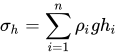
Hydrostatic stress = (σ11 + σ22 + σ33) / 3 = σh
 {\displaystyle \sigma _{h}=\displaystyle \sum _{i=1}^{n}\rho _{i}gh_{i}}
Shear stress terms: σ12, σ13, σ21, σ23, σ31, and σ32

Stress terms in the full tensor, using matrix notation:
{\boldsymbol  {\sigma }}=\left[{{\begin{matrix}\sigma _{{11}}&\sigma _{{12}}&\sigma _{{13}}\\\sigma _{{21}}&\sigma _{{22}}&\sigma _{{23}}\\\sigma _{{31}}&\sigma _{{32}}&\sigma _{{33}}\\\end{matrix}}}\right]\equiv \left[{{\begin{matrix}\sigma _{{xx}}&\sigma _{{xy}}&\sigma _{{xz}}\\\sigma _{{yx}}&\sigma _{{yy}}&\sigma _{{yz}}\\\sigma _{{zx}}&\sigma _{{zy}}&\sigma _{{zz}}\\\end{matrix}}}\right]\equiv \left[{{\begin{matrix}\sigma _{x}&\tau _{{xy}}&\tau _{{xz}}\\\tau _{{yx}}&\sigma _{y}&\tau _{{yz}}\\\tau _{{zx}}&\tau _{{zy}}&\sigma _{z}\\\end{matrix}}}\right]

Hydrostatic stress is isotropic, meaning that it acts the same way in all directions.
{\displaystyle \sigma _{h}\cdot I_{3}=\sigma _{h}\left[{\begin{array}{ccc}1&0&0\\0&1&0\\0&0&1\end{array}}\right]=\left[{\begin{array}{ccc}\sigma _{h}&0&0\\0&\sigma _{h}&0\\0&0&\sigma _{h}\end{array}}\right]}

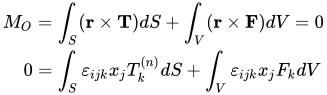
Under the conservation of angular momentum the moments (with respect to an arbitrary point) from the stresses on the faces must balance, and it becomes clear that the tensor must be symmetric:
{\displaystyle {\begin{aligned}M_{O}&=\int _{S}(\mathbf {r} \times \mathbf {T} )dS+\int _{V}(\mathbf {r} \times \mathbf {F} )dV=0\\0&=\int _{S}\varepsilon _{ijk}x_{j}T_{k}^{(n)}dS+\int _{V}\varepsilon _{ijk}x_{j}F_{k}dV\\\end{aligned}}}

or in simpler terms:
{\displaystyle \sigma _{12}=\sigma _{21}} AND {\displaystyle \sigma _{23}=\sigma _{32}} AND {\displaystyle \sigma _{13}=\sigma _{31}} OR:
{\displaystyle \sigma _{ij}=\sigma _{ji}}

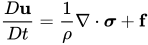
The stress tensor is a fundamental piece of the Cauchy momentum equation, which relates:
the material derivative, {\displaystyle {\frac {D\mathbf {u} }{Dt}}\ [\mathrm {m/s^{2}} ]}
the divergence of the stress tensor, {\displaystyle \nabla \cdot {\boldsymbol {\sigma }}={\begin{bmatrix}{\dfrac {\partial \sigma _{xx}}{\partial x}}+{\dfrac {\partial \sigma _{yx}}{\partial y}}+{\dfrac {\partial \sigma _{zx}}{\partial z}}\\{\dfrac {\partial \sigma _{xy}}{\partial x}}+{\dfrac {\partial \sigma _{yy}}{\partial y}}+{\dfrac {\partial \sigma _{zy}}{\partial z}}\\{\dfrac {\partial \sigma _{xz}}{\partial x}}+{\dfrac {\partial \sigma _{yz}}{\partial y}}+{\dfrac {\partial \sigma _{zz}}{\partial z}}\\\end{bmatrix}}[\mathrm {Pa/m=kg/m^{2}\cdot s^{2}} ]}
density at a point, {\displaystyle \rho \ [\mathrm {kg/m^{3}} ]}
and the accelerations caused by body forces (gravitational acceleration mostly), {\displaystyle \mathbf {f} ={\begin{bmatrix}f_{x}\\f_{y}\\f_{z}\end{bmatrix}}\ [\mathrm {m/s^{2}} ]}

So all put together, a form of the Cauchy Momentum equation:
{\displaystyle {\frac {D\mathbf {u} }{Dt}}={\frac {1}{\rho }}\nabla \cdot {\boldsymbol {\sigma }}+\mathbf {f} }
[further explanations of these terms below]

This describes momentum transport in any continuum (not just fluids), and from the Cauchy Momentum equation, the Navier-Stokes equations can be derived. The N-S equations describe the motion of viscous fluids in continuum mechanics. These equations are fundamental to the field of fluid mechanics (and are of mathematical interest).

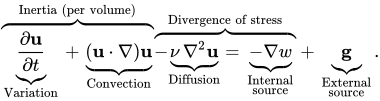
Navier-Stokes equations (incompressible form):
{\displaystyle \overbrace {\underbrace {\frac {\partial \mathbf {u} }{\partial t}} _{\begin{smallmatrix}{\text{Variation}}\end{smallmatrix}}+\underbrace {(\mathbf {u} \cdot \nabla )\mathbf {u} } _{\begin{smallmatrix}{\text{Convection}}\end{smallmatrix}}} ^{\text{Inertia (per volume)}}\overbrace {-\underbrace {\nu \,\nabla ^{2}\mathbf {u} } _{\text{Diffusion}}=\underbrace {-\nabla w} _{\begin{smallmatrix}{\text{Internal}}\\{\text{source}}\end{smallmatrix}}} ^{\text{Divergence of stress}}+\underbrace {\mathbf {g} } _{\begin{smallmatrix}{\text{External}}\\{\text{source}}\end{smallmatrix}}.}

This form has been simplified for use with incompressible fluids (like water), and for a Newtonian fluid (fluid with shear stress directly proportional to fluid velocity) like water the diffusion term describes the 'diffusion of momentum' through the fluid. And if the 'external source' describes a conservative field, the internal source (thermodynamic 'specific' work) can be combined with the external source to give hydraulic head pressure, or just the fluid pressure:
{\displaystyle {\frac {\partial \mathbf {u} }{\partial t}}+(\mathbf {u} \cdot \nabla )\mathbf {u} -\nu \,\nabla ^{2}\mathbf {u} =-\nabla h.}

What about the stress tensor? Where is it? From the Cauchy Momentum equation, the stress tensor disappears but yields a direct relationship, through fluid viscosity Î¼, to the rate of change of velocity in each direction, which is a useful and easily measurable / observable quantity in fluid motion:
\tau =\mu {\frac  {\partial u}{\partial y}},

Wikipedia has an excellent description of this constitutive equation:


That's pretty much the point of the stress tensor. It's a very useful concept that under-girds many significant and practical calculations in myriad fields of mechanics from weather models, to fluid mechanical models, to physics engines used in video games.

Descriptions of pieces of the Cauchy Momentum equation
[Material derivative]: describes the rate of change of the velocity field (local velocity of the fluid) in time and space{\displaystyle \partial _{t}\mathbf {u} +\mathbf {u} \cdot \nabla \mathbf {u} }

[divergence of the stress tensor]: describes how the force per unit volume (dimensions and units: 'Pressure / length' SI units are Pa / m = (N / m^2) /m = N / m^3 which gives dimensions 'Force / volume' equivalence) is related to how the stress tensor components change with each direction. This is essentially telling you how the force on a face (per unit volume) is related to how much the stress components on each face are changing in the direction they act.

Saturday, February 15, 2020

Why Calvin?

I was 18.

My dad said something like "you should go to Calvin. I would like it if you went to Calvin, and we will help you."

Calvin College had a chemical engineering program, and at the time I told people that I wanted to study engineering at a Christian college. I told them that. I probably thought it. Probably.

I definitely went to Calvin because it offered chemical engineering, and I probably went because it was a Christian college--I grew up in a Christian community you see.

At this moment [actually a few years ago now], Calvin College is conducting Vision 2029. Vision 2029 is a college-wide program and forum aimed at asking good questions regarding the role and trajectory that Calvin will adopt.

Today I attended the panel discussion: “Will Calvin be a Comprehensive Liberal Arts College or a Liberal Arts University?”

Question that arose were "why Calvin?" and "what makes Calvin distinctive?" and "what are our non-negotiables?" with the required (and hopefully not overlooked) subtext: "what are the preceding for an 18 year old?"

I don't pretend to speak for the rest of 18 year olds in the history of 18 year olds considering Calvin, but for my part, that list contained three items:

1. chemical engineering*
2. attractive (reformed) women**
3. residence in the Christian bubble***

*Ok. Yes. Still very pleased about this one
**"The basis of optimism is sheer terror" --Oscar Wilde
***Not the desire for growth in my faith or a deep connection with Christ--more of a cultural imperative

Fortunately for me, I did attend Calvin despite a less than impressive (and retrospectively embarrassing) rationale.

There are many reasons I count myself fortunate for attending Calvin despite being an idiot 18 year old (many would say still an idiot 28 year old [I wrote this in the fall of 2017 and now return to publish it]). I value:

the paper I wrote (truly, truly) poorly analyzing Biblical themes in the 'Russian Primary Chronicle' for History of the West and the World I,

the physics seminars I attended to earn honors credit, and for which I wrote an insipid description of gravitational lenses in Introductory Physics: Mechanics and Gravity,

the immediate, thoughtful (and truly mind-blowing) criticism of the Bible, and exposure to a diverse body of scholarship and views regarding who Jesus was, as a first-semester freshman taking Biblical Literature and Theology,

attacking (engaging really) secular and Christian philosophy directly, with abandon, and without fear in Fundamental Questions in Philosophy with a man who gave us students dignity and the best example of a Christian intellectual I ever met,

an international internship which had me training, training, and planing about Europe and learning sophisticated industrial organic chemistry development in a foreign language (driving my eventual pursuit of graduate study),

and

a broad, functional knowledge of not just my own discipline of chemical engineering, but the ability to speak and work intelligently and effectively with other engineers and scientists in different fields.

As a senior in high school, I question that any of these would have thrilled me as they do now, even if I could now posit their existence to a past self. I recognize them now, after completing graduate study, and taking up teaching.

I certainly would not have relished the thought that, most importantly, Calvin prepared me well to lose my faith in graduate school. For that I am grateful--putting together the pieces of a shattered mess has given my resurrected faith a life it never had.

Vision 2029 will fail if it only addresses "why Calvin" and "what are our non-negotiables" for parents of prospective students that want them to come here. I believe that everyone will agree with me on that point, but to me it bears crying from the rooftops and not treating as a polite, obvious observation. Calvin was truly transformative for me in the most dramatic way after I left.

However it wasn't transformative in any of the ways I would have wanted it to be, or expected it to be as a prospective student.

We cannot foist perspective onto students, we can only give them the opportunities to earn it themselves--that begins with their introduction to Calvin as high school seniors. I wonder if it will take walking a line between humble self-promotion, and vulnerability rendered salient.

[2020 perspective]
The move to 'university' has been completed. Let's add ", or just calling ourselves a university." to the last sentence.
I just read a flowery and not particularly substantive vision of the university structure written for the internal Calvin community, and all it did was to confirm my bias against an ever expanding corps of college administrators projecting a disconnected vision. The questions posited in the aforementioned panel appear to be foregone conclusions looking back. I still value Calvin and the place it is, but I've been struck lately by a lot of self-congratulation and lip service paid, when simply creating relationships between departments and companies, organizations, etc. doing similar work (as an alternative to saying) pays the real bills to establish community and inclusion and brings value to students.

Thursday, June 20, 2019

Acknowledgment r02

You were cruel to me,

rancorous in singling me out.

As I worked more and more,

in excess of 80 hours each week,

you advised me to seek counseling

instead of treating me with respect;

you contributed to my waking dread

through every sneer and disdainful stare

and howl during weekly face-to-face dress-downs.


I don't know why you needed to treat me

like dirt--if it was the pressure of being

a new faculty member, or the shadows cast

over you by your partner and other young faculty,

or if it was the stress of motherhood in the academy,

but it showed me a wonderful way not to treat

any person I will ever come into contact with,

especially those in my care or supervision.


Investigation capability in spades does not make

one kind or understanding or capable of managing

effectively. I only wish that I had not worked in your lab.

I could have learned what I did with significantly less pain

and without worrying that my confidence would be ruined

forever. A shame you needed to crush my dream with your insecurities.

Wrinkles like these don't quickly smooth--don't fade with time.

Sunday, June 16, 2019

Genetic recombination & 23andMe

Today (when I started this post many months ago) I compared the results of my genetic sequencing with my parents (predictable to be honest). We share a lot--and my parents share none between the two of them.

I'll be transparent. Much of what I learned in 10th grade biology was beyond my ability to apply practically here, and despite doing significant work in mechanobiology and TA'ing a biomolecular engineering class in grad school I was floundering trying to come up with an explanation for completely identical, half identical, and nonidentical segments.

The completely identical and nonidentical were simple concepts. If you compare with a sibling, then the genetic material you received from your parents is the same on both "halves" of the chromosome for identical segments. Nonidentical segments are when neither of the chromosome halves match up.

I highly recommend this post from Barry Starr at Stanford (Ask A Geneticist). He actually explains what most articles fail to address on a meaningful level.

My goal is to briefly recap Barry's explanation, and expound on the possibilities.

Let's start with two parents:
                                                 Mom                                       Dad
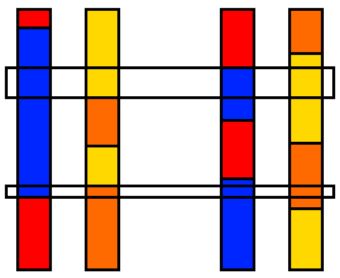
They each have genetic code inherited from their parents. We'll identify genetic material in their offspring as coming from a particular chromosome using these colors. On the left, is a chromosome pair of one parent (yellow & orange), and on the right is a chromosome of the other parent (blue & red).

These parents have two children:
                                            Kid A                                             Kid B
Each child inherits material from one parent on one half of the chromosome, and material from the other parent on the other half.

If you consider Kid A, the left chromosome of the pair comes completely from dad, so that whole segment is "half identical" with dad. The right chromosome of Kid A's pair is "half identical" with mom because it contains genetic material entirely from mom.

Ok, now let's compare the siblings to each other.

The following segments are "completely identical" between the two kids:
                                             Kid A                                          Kid B
In the boxes you can see that the colors of each pair match--this is a segment that is "completely identical" because it contains the exact same genetic material from each parent.

Results from the site 23andMe display full siblings the following way (7 chromosomes shown):
Consider chromosome #2 above. The purple color refers to the boxed portion of our siblings above--this part of the chromosome is shared identically by both siblings.
There are large segments in purple, but there is significantly more in the pink color. Pink is referring to "half identical" segments.

The following segments are "half identical" between the two kids:
                                              Kid A                                         Kid B
In the top box the kids share DNA from Dad (red), in the second box the kids share DNA from mom (yellow), in the third box the kids share DNA from Dad (blue), in the fourth box the kids share DNA from data (blue), and in the fifth box the kids share DNA from mom (orange). In each case, the second non-matching chromosome in the pair still contains genetic material from the other parent, but it comes from a different half of the parent's chromosome compared to their sibling.


That leaves "nonidentical" segments. In the 23andMe manner of displaying the comparison it's represented with light grey lines.

The following segments are "nonidentical between the two kids:
                                              Kid A                                         Kid B
None of the boxed segments have the same DNA between the two kids (though if you look closely you can see that I goofed a smidge, and the yellow/orange transition in the middle box doesn't line up perfectly).

Ok, so hopefully the terms are more meaningful, but what of incidence?

Let's isolate small segment and look at the possibilities.

The left half of each chromosome can come from either of Dad's pair, and the right half of each can come from either of Mom's pair, so each of the four above can have two possibilities--this means there are 2 × 2 × 2 × 2 = 16 possibilities.

Let's attribute them all among the three categories:

Completely identical (four)
Red Yellow Red Yellow
Blue Yellow Blue Yellow
Red Orange Red Orange
Blue Orange Blue Orange

Half identical (eight)
Red Yellow Red Orange
Red Orange Red Yellow
Blue Yellow Blue Orange
Blue Orange Blue Yellow
Blue Yellow Red Yellow
Blue Orange Red Orange
Red Yellow Blue Yellow
Red Orange Blue Orange

Nonidentical (four)
Red Yellow Blue Orange
Red Orange Blue Yellow
Blue Yellow Red Orange
Blue Orange Red Yellow

These give us rough proportions to expect. This is a VERY simplified set of proportions, but they get us in the ballpark.
Keep in mind that you can basically do this with billions of segments if we think of the above diagrams as small numbers of base pairs. According to wikipedia:
The centimorgan is also often used to imply distance along a chromosome, but the number of base pairs it corresponds to varies widely. In the Human genome, the centimorgan is about 1 million base pairs.
Over numbers that large, you're going to get reasonably close to an expected value.

When I compared the ratio of completely identical to half identical segments between my brother and I, sure enough, I got about 0.33. When you take the "completely identical" possibilities and divide by the sum of "half identical" and "completely identical" segments you get 0.33. The reason I do this is because it appears that 23andMe includes "completely identical" in the "half identical" segments portion from how they're counted in the analysis. Both are referred to as "shared."
The following are some of my numbers to show how close it can be to 50%:


Reference the following from the ISOGG wiki:
Neither 23andMe nor Family Tree DNA distinguishes between fully identical regions and half-identical regions when computing the number of shared centiMorgans (cMs). Thus, for example, the shared cM for full-siblings will on average be 75% of the total length of the genome, of which on average 50 percentage points are half-identical and 25 percentage points are fully identical.
**Different companies do the calculations in different ways, using different methods, so results can't be compared directly, unless you go through some work to put the numbers on the same basis.**

If we reconsider our rough proportions from the "16 possibilities" this agrees nicely. The "Completely identical" section is counted twice in the last segment because both "sides" (one from each parent) are the same--see the diagrams from "Completely identical" above.
Notice in my example that (13.1% + 26.1%) x 2 = 78.4%--pretty close to 75%.


All that being said, siblings share about 50% of dna with each other, and about 50% with each parent.

23andMe list a table of average shared DNA by relationship: here.


The International Society of Genetic Genealogy also weighs in (again, more information).

Sunday, July 22, 2018

KeePass 2 password manager

I've been recycling passwords based on two themes from past experience that aren't particularly clever. My strat is not swoll, and it keeps me guessing as to which permutation belongs to which account.

This is the experience and modus operandi of many when it comes to online security--bank accounts, the email account you use to change ALL of your passwords with, bill paying, online vendors, social media, work benefits, etc.

What if you lost access to that primary email account? Would you be excited and capable to start from scratch? I'm going to be frank--for me it would be devastating.

Fortunately password managers have been around for quite some time. There are feature-rich, subscription services and more spare, manual intensive (sometimes free) offerings, and everything in between.

Recently I started using KeePass 2.

This manager uses a locally stored, encrypted file to house passwords. It is opened with either a master password, or a master password + unique key file.

I'll detail my setup, because I think it's flexible enough for anyone to use it reasonably easily (security geeks will cry because it totally mitigates KeePass 2 advantage of having a local file, but I'm ok with that because I'm a nobody, and this is very convenient).

Requirements:
USB drive (cheap, probably laying around)
Dropbox (or other cloud storage drive--most are free to use for the basic version)
KeePass 2 software (open source, free to use)
KeeAnywhere (free to use plugin | getting started)
HaveIBeenPwned (free to use plugin)

Process:
1. I downloaded the latest version of KeePass 2 to my primary desktop at home. This will include the ability to use multiple computers, and even a work computer. You can use the "Installer for Windows" .exe file if that's appropriate for your system. There are many supported systems.

2. After install, you need to create a database for your passwords: File > New. This is where you will set your master password. YOU MUST NOT FORGET THIS PASSWORD, BUT IT WILL BE THE ONLY ONE YOU NEED TO REMEMBER (and you can add a key file if you choose--don't lose that either if you choose to go that route).

First steps

To follow the method I use, you should save this database file in a cloud storage drive (Dropbox, Google Drive, etc.). The installation you did on your home computer will allow you to select it locally if you have Dropbox or another cloud storage program installed on your computer.

3. Now that you have a database you can start adding to it. I did this by looking at the passwords I was storing in my browser, and adding those first--then remove them from your browser! You can add them all at once, or slowly accumulate them as you remember which accounts you actually have. You're now set up to use the software with your current passwords without relying on an unsecured browser to remember them, or you can use the built-in password generator to change to better passwords.

4. To use the same synced database on multiple computers however, we have to (maybe) use a plugin. This is the KeeAnywhere plugin linked above. It lets you open a database file from cloud storage.

On the second computer you will be using (maybe a laptop), install KeyPass 2.

If you already have your cloud storage accessible locally on this computer (e.g. you're running Dropbox) then you're all set, and can just open your file from wherever your Dropbox files are stored.

However, if you don't have your cloud drive running with local files on your computer you'll need KeeAnywhere.
Go to the "getting started" page I linked above and add the plgx file to your "Plugins" folder located wherever you installed KeyPass 2 to (probably in "Program Files" somewhere. To install the plugin, you'll need to close then re-open KeyPass 2.
It usually requires admin access, so you may not be able to do this at work (Side note: my work IT allowed me to install KeeAnywhere because they support using password managers--it never hurts to ask).

5. After re-opening KeyPass 2, go to: Tools > KeyAnywhere Settings...
This will take you to a dialog that will let you link to accounts (first steps). You can then open your database file: File > Open > Open From Cloud Drive...

6. Cool. Now you can save your database from this computer, and because it opened the file from your cloud drive it also saves the file to your cloud drive--both computers have access to the same database. Keep in mind that this method relies on you (or the nice people at Dropbox, Google Drive, etc.) to keep your database file backed up.

7. If you want to take your database anywhere and use computers where you might not have install permissions (e.g. at work, the library, a friend's house), we can solve that too. Get out your USB drive and plug it into your computer.

Go back to the downloads page and instead of the .exe version, download the "Portable" .zip file and save it on your USB drive.

After you extract the files on your USB, you can run the program directly from the USB without needing to install it on a work or public computer.

8. Go through the same process of installing the KeeAnywhere plugin to your USB "Plugins" folder and adding the cloud drive and database of your choosing.

VOILA--now you have access to your computers in multiple locations.

===================================================

But your passwords are terrible and you really need to get those cleaned up.

"Ohhhh, but I don't want to," you whine, "nobody will care about stealing anything from little old me."

It's funny you should think that. Your passwords have already been stolen--you've been pwned. Don't look at me! I didn't steal your data! Though I'd love to...all that sweet, juicy data :P

They were stolen from Adobe, Dropbox, LinkedIn, Gawker, Tumblr, AND SO MANY MORE!

You can even check if your email info was breached, from here.

Now that you've got a sweet database of your passwords though, let's use a plugin to check the security of your passwords, so you can change any that have been compromised.

This is when you put the plgx file from the HaveIBeenPwned plugin into the "Plugins" folder of one of your installations. You'll need to install it separately in each installation of KeePass 2 if you want the plugin available on all your computers.

After re-opening KeePass 2, go to: Tools > HaveIBeenPwned.

You can check your database by site/service, username, or password.

Use the plugin to check against both available databases provided, and then change your passwords if you haven't already. You'll have to log in to each separate account and do it manually from there.

There may be some false positives due to the way the search is run, but you can be pretty confident that if you used the password generator to change one and had between 15 and 32 characters (upper and lower case with numbers--and maybe even special characters), that your password is secure.

Happy safe passwords.

AND REMEMBER TO DEFINITELY NOT FORGET YOUR MASTER PASSWORD.
Put it in a safe or something if you need to.

Saturday, June 02, 2018

An emphatic no

Will Calvin be a Comprehensive Liberal Arts College or a Liberal Arts University?

This question was being considered at a panel discussion I attended last fall, and questions were being asked as to the questions we should ask when considering such a question. Ha! I know.

In the time between when I started this post and its publication the question has been answered: yes.

I concede that this question is relevant, valuable, and necessary to consider for the health of Calvin as it continues into the 21st century.

As an engineer I scream: "Calvin should not be a Liberal Arts University!!!!*"

*whatever L.A.U. means, and however you define it, which is still being worked out in earnest

Perhaps there is room for compromise: "engineering at Calvin should not be expected to expand into an R1 mode!!!!"

It feels like I'm deflecting from the question at hand, however I think the case of engineering maps reasonably well to the rest of the departments at Calvin.

Our engineering department is great at many things. We have dedicated, knowledgeable teachers who come from diverse industrial and academic backgrounds and disciplines. These women and men care deeply about engineering, love the discipline, and care for the health and edification of their students--faculty at R1 institutions also care deeply about their students, however their primary focus in many cases is facilitating excellent research programs, which is a beneficial yet fundamentally different aspect of education and the academy. The primary focus for Calvin faculty is not on grant applications and research program direction.

It's not about being approachable (the doors to faculty offices at R1's are open to students), but rather has to do with the focus of the faculty. Intention gets you far, but purpose is at the heart of Calvin's devotion to equipping students (recite it with me! with gusto!) to think deeply, to act justly, and to live wholeheartedly as Christ's agents of renewal in the world.

I loved the time I spent in graduate study at an R1 institution. It gave me an enormous appreciation for R1 institutions, and more so for the engineering program at Calvin College.

As a TA in engineering, it was clear that while undergraduate students were to be cared for, research was the focus and the important factor. I have never felt this sentiment at Calvin while as a student, nor while as a member of the teaching staff. We do excellent research here--it remains student-focused.

Calvin is good at letting students do any and all of the things they desire (though it may take a bit of time) because Calvin is hyper-permeable. Debra Rienstra, of the english department, made a great point about permeability in education, and allowing students the option to passionately study engineering and music, for example. This is so easy to do at Calvin--talented students do it often.

Personally I was able to pursue both chemical engineering and chemistry majors (a pairing that dovetails almost too easily) and felt integrated and welcomed in the chemistry department though my degree would ultimately be in engineering. I also personally know many students who have combined music with engineering, or public health, or literature--permeability!

The matter of purposeful student development is of real practical meaning and action to me. I taught at Calvin for a few years now and have found renewed purpose and academic redemption of sorts.

So what does Calvin gain? An excerpt from the official press release:
Le Roy says the rationale for Calvin becoming a university is strong, including Calvin’s strength, breadth, and depth of its academic programs; new opportunities for academic innovation; and the college’s increasing influence with students and higher education partners around the globe. The college also has a large international student population for whom “university” is more visible and better understood than “college.”
Calvin leaders also see the university structure combined with increased collaboration as creating a more prominent platform for the institution to express its mission through opportunities and innovation within and across disciplines, professional programs, and centers and institutes.

“A move to a university with a liberal arts foundation both names what we already do and liberates us to do that work better,” said Kevin den Dulk, political science professor at Calvin College and executive director of the Henry Institute. “I’m especially enthusiastic about using the university structure to expand our global reach, which is already considerable yet has a lot of room to grow.”
The bulk of the argument seems to hinge on recognition from international students. I understand the idea that with declining domestic enrollment, it will be key to bolster international recruitment and admissions. But surely reputation and name recognition go beyond the distinction between 'university' and 'college.' Are we now relying on a prospective student or parent to perk up at reading 'Calvin University' on print material, when 'Calvin College' would have caused them to merely gloss over it and move on? This is a weak premise to hang our hat on. Since I've heard 'international recognition' repeated more than almost any other talking point, I don't think this is a mischaracterization.

I truly don't see what the university structure of colleges versus departments will do to facilitate "increased collaboration" and innovation. Innovation and cross department collaboration have been happening for years: ISRx a project melding biology and chemistry departments, and the various interims and summer programs that unite business, engineering, and german programs are two prominent examples that have paid enormous dividends for the departments in question.

Finally let's consider the professional programs. From the standpoint of engineering, I just don't see where the funding is going to come from to provide for post-baccalaureate educational opportunities. Our engineering building is already at capacity hosting senior design team efforts. Where are the research facilities going to appear from for students to do thesis research on one or two year master of engineering programs? Where is the lab space going to open up for chemistry or biology PhD work? No one is arguing for an immediate ascent to R1 status of course, but I also haven't seen a coherent vision of what Calvin University will mean for the different departments/colleges. Certainly such a vision would not need to be set in stone, but I haven't heard even a whiff of a plan for my department, and that concerns me.

Calvin seems to be doing just fine without a 'university structure.' I truly hope that this choice was not made for feathering caps, and prestige.

We'll see what visions develop.

Wednesday, October 04, 2017

Civic engagement

After a conversation with friends last week, I decided to take action in a simple, thoughtful way.

We were talking about the cost of education, and the kinds of tax breaks you can expect to receive based on the interest you're paying on student loans--the best you can do is to deduct $2,500 of the money you pay in interest on them. It's not a credit.

And at this point, we're not even talking about the possibility of paying a mortgage if you want to own a house. At least with a house you can deduct all of your interest payments...

That seemed woefully inadequate to me, so I wrote this up in a couple hours on a Friday afternoon. Feel free to peruse, use, wholesale copy, or otherwise, and send to your representative and senators if you feel so inclined. Maybe make a call or visit an office.

I did so this week.

Has anyone else done something similar lately? The benefit of having a madman trying to run the nation is that civic engagement seems up.

Monday, March 20, 2017

I believe...[work in progress]

God exists

-[this is the critical, frustrating point that I will never be able to prove, and will honestly, probably always feel uncertain about]

-if I accept that, then the Bible relates that:

--Jesus is the son of God, who came into time and space

--Jesus sacrificed union/love/relationship with the Father on our behalf in a singular way

--we choose to distance ourselves from God in sin

--the penalty for sin is its fulfillment--separation, probably eternal--practically I don't know what that means

--Jesus gives us life freely

--the kingdom of God is greater than my salvation

--the work of the church is to bring the kingdom of God on earth--this happens in sometime conflicting and inconsistent ways (see the Bible)

-the Bible is the story of God's people (in part descriptive, prescriptive, and corrective)--it's God's word, but it is not the Word, nor is it God

--in the Beatitudes Jesus turns power on its head and shows his kingdom priorities

--Parables of the Kingdom tell us how Jesus thought of what was to come:
---the parable of the weeds says that God acknowledges human suffering and strife before his coming Kingdom
---the parable of the sower says that it is difficult to follow Jesus; it is difficult to have faith even; the Gospel of Jesus produces real change in people
---the parable of the hidden treasure describes the way a person gladly gives up his life and possessions, in a way that may be impossible to understand, in order to gain an even more precious way of life
---the parable of the pearl, in a similar way tells of the value of the Kingdom of heaven--worth more than any current power
---the parable of the growing seed reassures those tasked with Kingdom building that their labor is not in vain--a new thing is growing
---the parable of the mustard seed describes the extent and breadth of the pervasive Kingdom
---the parable of the leaven tells of how the Kingdom of God is inevitable after introduction of yeast--surely the resurrection of Jesus

-Jesus is the best thing for everyone because his resurrection is the preview of God's plan for a kingdom made right

-our fellow man deserve love not because they are objects to be converted, but because they are loved by the creator as much as I am

-faith is mysterious and maddening--sometimes I hate it