Showing posts with label Boiler Primer. Show all posts

Thursday, February 19, 2015

Boiler Primer 3: pH, alkalinity and conductivity

Understanding the environment that reactions take place in helps us to determine which are more likely.  Variables like pH and alkalinity do that, because they tell us what form a species is in.  For example carbonates, which are the components of alkalinity have two protonation states, since H2CO3 is diprotic.  It is an acid that is able to give up two protons.
H2CO3 <=> HCO3− + H+
Ka1 = 2.5×10⁻⁴;[1] pKa1 = 3.6 at 25 °C.
HCO3− <=> CO32− + H+
Ka2 = 4.69×10⁻¹¹; pKa2 = 10.329 at 25 °C and ionic strength = 0.0 (data from wikipedia)
These two pKa values describe the extent to which one of the species is present at a certain pH.  See the speciation plot below for carbonic acid (source):
This means that at low pH, carbonic acid is primarily in its H2CO3 state.  Most of the carbonic acid molecules have given up their first proton by pH 6, and most of those have given up their second proton by pH 9.5 to become CO3.  Thus, above pH 10, CO3 exists as the dominant species.  It is a weak base.  This water is high in alkalinity therefore, but not corrosive.

We like to operate at this pH, because it dramatically reduces the corrosion from oxygen and other sources such as carbonic acid (source):
However, it means that we have a large cohort of CO3 present, which is amenable to reaction with calcium to form calcium carbonate.  Because this is a scale forming environment, we address this with dispersants and inhibitors that get to the calcium before it can form scale.

Conductivity then is a measure of the amount of dissolved solids in water.  This increases as more salts are available in solution to conduct electrons.  This is essentially one number that helps to boil down how full the water is of ions (alkalinity, treatment, hardness).  Water with higher conductivity tends to have more possible reactions as well, shifting equilibrium toward scale formation.  Conductivity is a measure that we use to manage how often blowdown occurs--how often we get rid of water that has many ions, and introduce makeup water with fewer ions, to reduce scale formation.

Boiler Primer 2: Treatment chemistry (low pressure)

Chemical reactions happen pretty quickly in a boiler because the temperature is so high, and reaction rate is generally dependent on temperature.  Some reactions that happen in a boiler are good, and some are bad.
Bad reactions:
Calcium scale formation on boiler tubes (solid deposits reduce heating efficiency)
Oxygen corrosion of steel (pitting and metal loss)

Good reactions:
Steel passivation (forms protective layer)
Calcium salt formation that remains soluble or in the bulk water (we can remove it with blowdown)
We combat bad reactions like calcium scale formation by adding chemicals that the calcium can react with to form small crystals in solution, instead of on the steel tubes in the boiler.  Combating oxygen corrosion involves the use of oxygen scavengers which react with the oxygen to form other compounds, and remove it from the water--what's not there can't do damage.  Nearly all of the following are formulated as sodium salts.  Sodium ions play nice, in general calcium do not.  Calcium often comes into the boiler through makeup water (replacement water for leaky valves or water lost to steam)--it is preferred to be removed with a water softener if possible, before being added to the boiler.

Corrosive Water Scale-forming Water
  • low pH
  • soft or with primarily noncarbonate hardness
  • low alkalinity
  • high pH
  • hard with primarily carbonate hardness
  • high alkalinity
The central dogma of boiler treatment currently is: mitigate corrosion almost completely through the use of an alkaline pH, and use chemistry to stymie unfavorable reactions.  There are some acidic treatments, but today most work is done at elevated pH (table source).

Hot loop chemistry:
Boilers that circulate hot water through a building are typically not blown down (removing water with a high level of dissolved salts).  Once properly treated, they can remain stable for months.  These systems are typically treated with nitrite (above), which passivates the steel by reacting to form a layer of magnetite (Fe3O4).  This is a less reactive oxide of iron that, unlike rust (Fe2O3), will not contribute to loss of boiler steel.  We like to see boiler water a little black (magnetite), rather than red (rust), because it means the steel has a protective layer on it.

Steam boiler chemistry:
Steam boilers present several problems that hot water boilers do not have.
The first difference is that these boilers are constantly losing water as steam, and need more water added as a result.  The steam that condenses has a relatively low pH (7 as opposed to boiler water, which is kept from 9-11).  This makes the water rather acidic and corrosive to the steel.  Combine that with carbon dioxide, which is dissolved in this water creating carbonic acid, and you get a nasty bit of acidic water.  To combat this, amines (cyclohexylamine, above) are added to the boiler water.  Amines vaporize within boiler operating temperatures and leave with the steam.  They also condense with the water and raise the pH (pKa similar to sodium hydroxide which is strongly basic).  This reduces the corrosion in the steel pipes that return the condensed water to the boiler.

Oxygen scavengers such as sulfite (above) and erythrobate are used to react with the oxygen that is dissolved in the feed water make up to the boiler.
Phosphates (above) are added to bind the calcium in small insoluble crystals that are unlikely to cause scale on the boiler tubes.  These eventually leave with the water that is blown out of the boiler periodically.

The above classes of chemical are the most common course of treatment for boilers, though there are others.
These are important considerations for low pressure boilers.  Boiler drums found in higher pressure systems such as power plants have different chemistries and considerations.

Wednesday, February 18, 2015

Boiler Primer 1: Introduction

What is a boiler?
A boiler is used to either heat water, or to heat water with the purpose of making steam.


Boilers do this by contacting water with a hot surface.  There are two general types, fire-tube (left) and water-tube boilers (right).  Water-tube boilers have water running through tubes, and the outside of those tubes are heated by burning natural gas, to heat the water running through them.  More commonly seen are fire-tube boilers.  These involve burning natural gas within the tubes and radiating the heat out to water that surrounds them.

Hot-water boilers are used to heat water which is sent in a loop throughout a building typically, or through a process in general.  These are often used to heat buildings by blowing air over the tubes through air handlers.  This system can be thought to function similarly to how an old radiator does--the kind that tend to bang, and are found in old homes, schools or offices.

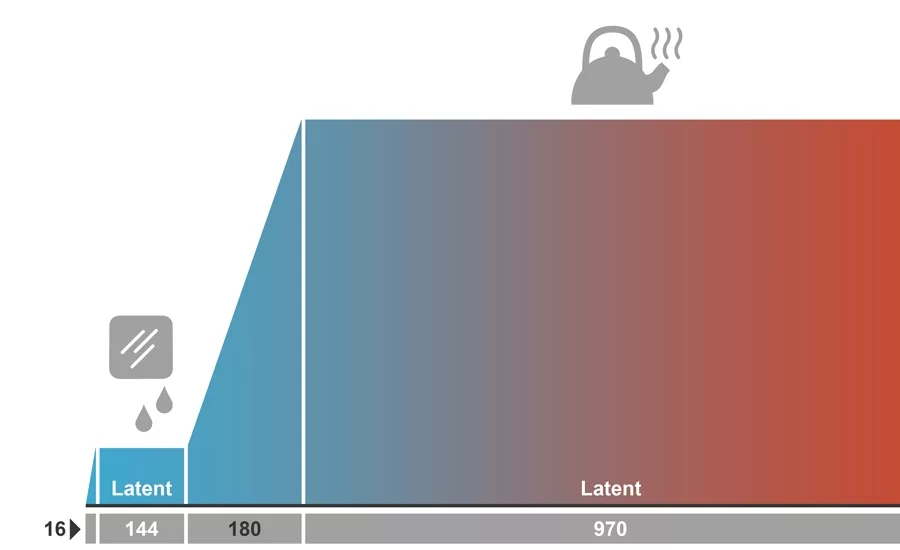
Steam boilers create pressurized steam by heating water.  The steam leaves the boiler through a header pipe and is passed to a process or wherever it is needed.  This steam that leaves is precious though, because it is mostly pure.  When water turns into steam, it leaves salts and most other chemical treatment behind in the boiler.  What happens after the steam deposits its heat of vaporization to a process, is that it condenses back into water because it lost the energy to be steam.  The condensed water is then very pure, because the steam was pure.  The condensate is then collected when possible, and fed back into the boiler.  Some boilers cannot do this because the steam is not part of a closed loop and goes elsewhere, but wherever possible, the pure water is collected and recycled, replacing the water that leaves as steam.
As you can see from the above diagram, there is an enormous amount of energy carried in steam.  This is the energy in steam that is applied to a process when the steam is allowed to condense.  That energy isn't free though, it comes from the combusted natural gas, but it allows us a more convenient way to pass energy along, using water/steam as a medium.