Showing posts with label Life. Show all posts

Thursday, July 30, 2026

Surprised by Hope vs Between the World and Me

Thematically, the coming of the kingdom of heaven, via the bodily resurrection in Wright's language, strongly parallels the inexorable struggle, and building of the "kingdom of black Americans" Coates describes. These kingdoms are not inevitable--they are built through struggle and the specific efforts and labors of people, fighting against the powers which abuse the purposes of God, and abuse black bodies. The world is not getting better in an evolutionary way or regressing into some apocalyptic rubble (or is it?).
Ta-Nehisi Coates is an atheist. He might appreciate the parallels literarily but likely would not be compelled by the concept of the kingdom of God. In the passage below he calls to resist "the comforting narrative of divine law" that implies "irrepressible justice"...and so does Wright. At least when it comes to our bringing the kingdom of God to earth.

Two quotes from Wright followed by one from Coates:
The point of the resurrection…is that the present bodily life is not valueless just because it will die…What you do with your body in the present matters because God has a great future in store for it…What you do in the present—by painting, preaching, singing, sewing, praying, teaching, building hospitals, digging wells, campaigning for justice, writing poems, caring for the needy, loving your neighbor as yourself—will last into God's future. These activities are not simply ways of making the present life a little less beastly, a little more bearable, until the day when we leave it behind altogether (as the hymn so mistakenly puts it…). They are part of what we may call building for God's kingdom.

What you do in the Lord is not in vain. You are not oiling the wheels of a machine that's about to roll over a cliff. You are not restoring a great painting that's shortly going to be thrown on the fire. You are not planting rosed in a garden that's about to be dug up for a building site. You are -- strange though it may seem, almost as hard to believe as the resurrection itself -- accomplishing something that will become in due course part of God's new world. Every act of love, gratitude, and kindness; every work of art or music inspired by the love of God and delight in the beauty of his creation; every minute spent teaching a severely handicapped child to read or to walk; every act of care and nurture, of comfort and support, for one’s fellow human beings and for that matter one’s fellow nonhuman creatures; and of course every prayer, all Spirit-led teaching, every deed that spreads the gospel, builds up the church, embraces and embodies holiness rather than corruption, and makes the name of Jesus honored in the world—all of this will find its way, through the resurrecting power of God, into the new creation that God will one day make. That is the logic of the mission of God. God’s recreation of his wonderful world, which began with the resurrection of Jesus and continues mysteriously as God’s people live in the risen Christ and in the power of his Spirit, means that what we do in Christ and by the Spirit in the present is not wasted. It will last all the way into God’s new world. In fact, it will be enhanced there.
N.T. Wright, Surprised by Hope

You must resist the common urge toward the comforting narrative of divine law, toward fairy tales that imply some irrepressible justice. The enslaved were not bricks in your road, and their lives were not chapters in your redemptive history. They were people turned to fuel for the American machine. Enslavement was not destined to end, and it is wrong to claim our present circumstance--no matter how improved--as the redemption for the lives of people who never asked for the posthumous, untouchable glory of dying for their children.
Ta-Nehisi Coates, Between the World and Me

I originally wrote this in FEB2017 after reading both books. Today I found the draft, wrote the second paragraph, and inserted the Wright quotes that I'd been holding as a placeholder.

Monday, July 27, 2026

Journey to becoming professional

 In college I first learned about who an engineer is and what they do and I also started learning about what it means to be a professional engineer.

My professor Wayne Wentzheimer shared that when he started working at ARCO Chemical after he completed his Ph.D. in 1969, it was made a requirement within the company that he and some of his colleagues become licensed. Unfortunately, I've forgotten why.

The F.E. had started being administered nationally in 1965 and had become a standardized machine-graded test in 1970 (NCEES had been founded in 1920 and Pennsylvania licensing board in 1921). The chemical P.E. was first offered in 1966. The process to become licensed in a standardized fashion was nascent but becoming more uniform. I believe he would have had both F.E. and P.E. standard tests available to him for licensing at the time in Pennsylvania - he took both in direct succession.

So, to me very early on in my education, the P.E. license became a kind of implicit requirement toward becoming an engineer. At the same time, I understood the context that the P.E. was a license typically more vital for civil and mechanical engineering careers due to their proximity to public works and the building design trade. It was an impractical achievement on the road to doing meaningful engineering work as a chemical engineer but also embedded in my perception of what it meant to be a competent and accomplished engineer. I didn't need it to do interesting work, but I wanted it to feel like I was a "real" engineer.

With that backdrop, I opted to take the Fundamentals of Engineering exam during the fall of my senior year mostly as a contingency option (you never know...what if?). We had a mini review bootcamp that was optional to attend in the evenings, which was very helpful. I then joined other students and professionals in the DeVos Place sitting at tables all day, silently pecking at calculators and filling in bubbles. The Calvin engineering education schedule had the controls class in the spring of the senior year, but other than that area, I felt well-prepared and was able to pass the exam (2010). And that's kind of where I left it - an engineer in training (E.I.T.) without much direct intention or need to move further.

My first job after graduate school was selling chemicals and doing engineering analyses for customers in support of selling chemicals (2014-2018). I didn't have any professional engineers at hand to oversee my work, and it didn't feel like it made much sense to find a P.E. to oversee and referee what I was doing. I was also under the mistaken impression that a non-P.E. was able to referee and direct qualifying experience.

Then I found work at a chemical company and the site director was licensed and could actually review and direct my work. It was also true of an eventual Disher colleague who is a P.E. and able to help me build qualifying experience. While at the chemical company I didn't really feel like I had the time to study and prepare for the P.E. test but was at least developing meaningful and significant experience in process engineering work at a chemical manufacturer.

Finally, when I left the chemical company to join Disher, I had what felt like the right time- and energy-balance (intentional pun) to actively pursue "the test". And I was also working at a food manufacturer doing qualifying project engineering work reviewed by my colleague. Ultimately, I started studying for a little over a year, a few hours per week, by taking and reviewing and re-taking the practice test published by NCEES. With trepidation and the strength-of-will from paying $400 in January (and not wanting to lose it), I set aside a day and took the test at the Grand Rapids 28th Street Pearson center - and I passed! What a relief and delight.

From there it was an administrative application to the State of MI with the right paperwork to get my license. After all the buildup of studying over the last year in earnest and long-term percolation in my head since I was a college student it was done in a very anti-climactic fashion.

My work mentioned it during an all-staff meeting and that's the end of this chapter (2010 - 2026!). What begins now is deciding if and how to use this license. And ultimately that's great.

I had built up the attainment of the P.E. license to be something it wasn't. It's not a pinnacle of achievement. It's really the minimum standard to work as the engineer of record on projects that impact the safety of the public in some fashion. It's a significant achievement, but it also demonstrates minimum competency and that was really good to realize and develop perspective around.

Monday, April 03, 2023

Book review - Sex, Gender, and Engineering: Harassment at Work and in School

 Amazon Review: Thorough coverage and filled with first-hand accounts - 

This tremendous and comprehensive text breaks down the language and impacts of sexual harassment in a meaningful and digestible fashion. Van Antwerp and Wilson delve into what's known about sexual and gender harassment from the literature and point out where work has yet to be done. The book is widely researched including both academic and workplace data and makes helpful distinctions between the two. For those of us who have not studied this area closely, they describe and modify several classic models including learning transfer, stress, and sexual harassment as it pertains to job satisfaction & its antecedents and impacts. This book is invaluable to me as an at-times college instructor and full-time manager of engineers - the differing landscapes are well characterized.

Finally this work attends to solutions and the future in very practical ways. The authors dig into effective learning transfer strategies, different training methodologies and approaches, and expound on the nature and value of bystander training and activism within the specific context of heavily systemized engineering spaces.

I have come away with discussions and ideas to implement with my team, concepts and training improvements to discuss with site leadership, and a better understanding of the importance of cultivating a culture that engenders solidarity with all workers - even a better understanding of my workplace.

Saturday, February 15, 2020

Why Calvin?

I was 18.

My dad said something like "you should go to Calvin. I would like it if you went to Calvin, and we will help you."

Calvin College had a chemical engineering program, and at the time I told people that I wanted to study engineering at a Christian college. I told them that. I probably thought it. Probably.

I definitely went to Calvin because it offered chemical engineering, and I probably went because it was a Christian college--I grew up in a Christian community you see.

At this moment [actually a few years ago now], Calvin College is conducting Vision 2029. Vision 2029 is a college-wide program and forum aimed at asking good questions regarding the role and trajectory that Calvin will adopt.

Today I attended the panel discussion: “Will Calvin be a Comprehensive Liberal Arts College or a Liberal Arts University?”

Question that arose were "why Calvin?" and "what makes Calvin distinctive?" and "what are our non-negotiables?" with the required (and hopefully not overlooked) subtext: "what are the preceding for an 18 year old?"

I don't pretend to speak for the rest of 18 year olds in the history of 18 year olds considering Calvin, but for my part, that list contained three items:

1. chemical engineering*
2. attractive (reformed) women**
3. residence in the Christian bubble***

*Ok. Yes. Still very pleased about this one
**"The basis of optimism is sheer terror" --Oscar Wilde
***Not the desire for growth in my faith or a deep connection with Christ--more of a cultural imperative

Fortunately for me, I did attend Calvin despite a less than impressive (and retrospectively embarrassing) rationale.

There are many reasons I count myself fortunate for attending Calvin despite being an idiot 18 year old (many would say still an idiot 28 year old [I wrote this in the fall of 2017 and now return to publish it]). I value:

the paper I wrote (truly, truly) poorly analyzing Biblical themes in the 'Russian Primary Chronicle' for History of the West and the World I,

the physics seminars I attended to earn honors credit, and for which I wrote an insipid description of gravitational lenses in Introductory Physics: Mechanics and Gravity,

the immediate, thoughtful (and truly mind-blowing) criticism of the Bible, and exposure to a diverse body of scholarship and views regarding who Jesus was, as a first-semester freshman taking Biblical Literature and Theology,

attacking (engaging really) secular and Christian philosophy directly, with abandon, and without fear in Fundamental Questions in Philosophy with a man who gave us students dignity and the best example of a Christian intellectual I ever met,

an international internship which had me training, training, and planing about Europe and learning sophisticated industrial organic chemistry development in a foreign language (driving my eventual pursuit of graduate study),

and

a broad, functional knowledge of not just my own discipline of chemical engineering, but the ability to speak and work intelligently and effectively with other engineers and scientists in different fields.

As a senior in high school, I question that any of these would have thrilled me as they do now, even if I could now posit their existence to a past self. I recognize them now, after completing graduate study, and taking up teaching.

I certainly would not have relished the thought that, most importantly, Calvin prepared me well to lose my faith in graduate school. For that I am grateful--putting together the pieces of a shattered mess has given my resurrected faith a life it never had.

Vision 2029 will fail if it only addresses "why Calvin" and "what are our non-negotiables" for parents of prospective students that want them to come here. I believe that everyone will agree with me on that point, but to me it bears crying from the rooftops and not treating as a polite, obvious observation. Calvin was truly transformative for me in the most dramatic way after I left.

However it wasn't transformative in any of the ways I would have wanted it to be, or expected it to be as a prospective student.

We cannot foist perspective onto students, we can only give them the opportunities to earn it themselves--that begins with their introduction to Calvin as high school seniors. I wonder if it will take walking a line between humble self-promotion, and vulnerability rendered salient.

[2020 perspective]
The move to 'university' has been completed. Let's add ", or just calling ourselves a university." to the last sentence.
I just read a flowery and not particularly substantive vision of the university structure written for the internal Calvin community, and all it did was to confirm my bias against an ever expanding corps of college administrators projecting a disconnected vision. The questions posited in the aforementioned panel appear to be foregone conclusions looking back. I still value Calvin and the place it is, but I've been struck lately by a lot of self-congratulation and lip service paid, when simply creating relationships between departments and companies, organizations, etc. doing similar work (as an alternative to saying) pays the real bills to establish community and inclusion and brings value to students.

Thursday, June 20, 2019

Acknowledgment r02

You were cruel to me,

rancorous in singling me out.

As I worked more and more,

in excess of 80 hours each week,

you advised me to seek counseling

instead of treating me with respect;

you contributed to my waking dread

through every sneer and disdainful stare

and howl during weekly face-to-face dress-downs.


I don't know why you needed to treat me

like dirt--if it was the pressure of being

a new faculty member, or the shadows cast

over you by your partner and other young faculty,

or if it was the stress of motherhood in the academy,

but it showed me a wonderful way not to treat

any person I will ever come into contact with,

especially those in my care or supervision.


Investigation capability in spades does not make

one kind or understanding or capable of managing

effectively. I only wish that I had not worked in your lab.

I could have learned what I did with significantly less pain

and without worrying that my confidence would be ruined

forever. A shame you needed to crush my dream with your insecurities.

Wrinkles like these don't quickly smooth--don't fade with time.

Sunday, July 22, 2018

KeePass 2 password manager

I've been recycling passwords based on two themes from past experience that aren't particularly clever. My strat is not swoll, and it keeps me guessing as to which permutation belongs to which account.

This is the experience and modus operandi of many when it comes to online security--bank accounts, the email account you use to change ALL of your passwords with, bill paying, online vendors, social media, work benefits, etc.

What if you lost access to that primary email account? Would you be excited and capable to start from scratch? I'm going to be frank--for me it would be devastating.

Fortunately password managers have been around for quite some time. There are feature-rich, subscription services and more spare, manual intensive (sometimes free) offerings, and everything in between.

Recently I started using KeePass 2.

This manager uses a locally stored, encrypted file to house passwords. It is opened with either a master password, or a master password + unique key file.

I'll detail my setup, because I think it's flexible enough for anyone to use it reasonably easily (security geeks will cry because it totally mitigates KeePass 2 advantage of having a local file, but I'm ok with that because I'm a nobody, and this is very convenient).

Requirements:
USB drive (cheap, probably laying around)
Dropbox (or other cloud storage drive--most are free to use for the basic version)
KeePass 2 software (open source, free to use)
KeeAnywhere (free to use plugin | getting started)
HaveIBeenPwned (free to use plugin)

Process:
1. I downloaded the latest version of KeePass 2 to my primary desktop at home. This will include the ability to use multiple computers, and even a work computer. You can use the "Installer for Windows" .exe file if that's appropriate for your system. There are many supported systems.

2. After install, you need to create a database for your passwords: File > New. This is where you will set your master password. YOU MUST NOT FORGET THIS PASSWORD, BUT IT WILL BE THE ONLY ONE YOU NEED TO REMEMBER (and you can add a key file if you choose--don't lose that either if you choose to go that route).

First steps

To follow the method I use, you should save this database file in a cloud storage drive (Dropbox, Google Drive, etc.). The installation you did on your home computer will allow you to select it locally if you have Dropbox or another cloud storage program installed on your computer.

3. Now that you have a database you can start adding to it. I did this by looking at the passwords I was storing in my browser, and adding those first--then remove them from your browser! You can add them all at once, or slowly accumulate them as you remember which accounts you actually have. You're now set up to use the software with your current passwords without relying on an unsecured browser to remember them, or you can use the built-in password generator to change to better passwords.

4. To use the same synced database on multiple computers however, we have to (maybe) use a plugin. This is the KeeAnywhere plugin linked above. It lets you open a database file from cloud storage.

On the second computer you will be using (maybe a laptop), install KeyPass 2.

If you already have your cloud storage accessible locally on this computer (e.g. you're running Dropbox) then you're all set, and can just open your file from wherever your Dropbox files are stored.

However, if you don't have your cloud drive running with local files on your computer you'll need KeeAnywhere.
Go to the "getting started" page I linked above and add the plgx file to your "Plugins" folder located wherever you installed KeyPass 2 to (probably in "Program Files" somewhere. To install the plugin, you'll need to close then re-open KeyPass 2.
It usually requires admin access, so you may not be able to do this at work (Side note: my work IT allowed me to install KeeAnywhere because they support using password managers--it never hurts to ask).

5. After re-opening KeyPass 2, go to: Tools > KeyAnywhere Settings...
This will take you to a dialog that will let you link to accounts (first steps). You can then open your database file: File > Open > Open From Cloud Drive...

6. Cool. Now you can save your database from this computer, and because it opened the file from your cloud drive it also saves the file to your cloud drive--both computers have access to the same database. Keep in mind that this method relies on you (or the nice people at Dropbox, Google Drive, etc.) to keep your database file backed up.

7. If you want to take your database anywhere and use computers where you might not have install permissions (e.g. at work, the library, a friend's house), we can solve that too. Get out your USB drive and plug it into your computer.

Go back to the downloads page and instead of the .exe version, download the "Portable" .zip file and save it on your USB drive.

After you extract the files on your USB, you can run the program directly from the USB without needing to install it on a work or public computer.

8. Go through the same process of installing the KeeAnywhere plugin to your USB "Plugins" folder and adding the cloud drive and database of your choosing.

VOILA--now you have access to your computers in multiple locations.

===================================================

But your passwords are terrible and you really need to get those cleaned up.

"Ohhhh, but I don't want to," you whine, "nobody will care about stealing anything from little old me."

It's funny you should think that. Your passwords have already been stolen--you've been pwned. Don't look at me! I didn't steal your data! Though I'd love to...all that sweet, juicy data :P

They were stolen from Adobe, Dropbox, LinkedIn, Gawker, Tumblr, AND SO MANY MORE!

You can even check if your email info was breached, from here.

Now that you've got a sweet database of your passwords though, let's use a plugin to check the security of your passwords, so you can change any that have been compromised.

This is when you put the plgx file from the HaveIBeenPwned plugin into the "Plugins" folder of one of your installations. You'll need to install it separately in each installation of KeePass 2 if you want the plugin available on all your computers.

After re-opening KeePass 2, go to: Tools > HaveIBeenPwned.

You can check your database by site/service, username, or password.

Use the plugin to check against both available databases provided, and then change your passwords if you haven't already. You'll have to log in to each separate account and do it manually from there.

There may be some false positives due to the way the search is run, but you can be pretty confident that if you used the password generator to change one and had between 15 and 32 characters (upper and lower case with numbers--and maybe even special characters), that your password is secure.

Happy safe passwords.

AND REMEMBER TO DEFINITELY NOT FORGET YOUR MASTER PASSWORD.
Put it in a safe or something if you need to.

Wednesday, October 04, 2017

Civic engagement

After a conversation with friends last week, I decided to take action in a simple, thoughtful way.

We were talking about the cost of education, and the kinds of tax breaks you can expect to receive based on the interest you're paying on student loans--the best you can do is to deduct $2,500 of the money you pay in interest on them. It's not a credit.

And at this point, we're not even talking about the possibility of paying a mortgage if you want to own a house. At least with a house you can deduct all of your interest payments...

That seemed woefully inadequate to me, so I wrote this up in a couple hours on a Friday afternoon. Feel free to peruse, use, wholesale copy, or otherwise, and send to your representative and senators if you feel so inclined. Maybe make a call or visit an office.

I did so this week.

Has anyone else done something similar lately? The benefit of having a madman trying to run the nation is that civic engagement seems up.

Monday, March 20, 2017

I believe...[work in progress]

God exists

-[this is the critical, frustrating point that I will never be able to prove, and will honestly, probably always feel uncertain about]

-if I accept that, then the Bible relates that:

--Jesus is the son of God, who came into time and space

--Jesus sacrificed union/love/relationship with the Father on our behalf in a singular way

--we choose to distance ourselves from God in sin

--the penalty for sin is its fulfillment--separation, probably eternal--practically I don't know what that means

--Jesus gives us life freely

--the kingdom of God is greater than my salvation

--the work of the church is to bring the kingdom of God on earth--this happens in sometime conflicting and inconsistent ways (see the Bible)

-the Bible is the story of God's people (in part descriptive, prescriptive, and corrective)--it's God's word, but it is not the Word, nor is it God

--in the Beatitudes Jesus turns power on its head and shows his kingdom priorities

--Parables of the Kingdom tell us how Jesus thought of what was to come:
---the parable of the weeds says that God acknowledges human suffering and strife before his coming Kingdom
---the parable of the sower says that it is difficult to follow Jesus; it is difficult to have faith even; the Gospel of Jesus produces real change in people
---the parable of the hidden treasure describes the way a person gladly gives up his life and possessions, in a way that may be impossible to understand, in order to gain an even more precious way of life
---the parable of the pearl, in a similar way tells of the value of the Kingdom of heaven--worth more than any current power
---the parable of the growing seed reassures those tasked with Kingdom building that their labor is not in vain--a new thing is growing
---the parable of the mustard seed describes the extent and breadth of the pervasive Kingdom
---the parable of the leaven tells of how the Kingdom of God is inevitable after introduction of yeast--surely the resurrection of Jesus

-Jesus is the best thing for everyone because his resurrection is the preview of God's plan for a kingdom made right

-our fellow man deserve love not because they are objects to be converted, but because they are loved by the creator as much as I am

-faith is mysterious and maddening--sometimes I hate it

Tuesday, December 27, 2016

Birds eat grass

I'm expectant and bubbling--effervescent and impatient.

The semester is over. I've graded the students; I've graded the course & myself.

Work continues such as it is. Folks & products are heated & cooled. Oil lubricates and is washed away.

But I. I sit on the edge of a precipice.

It might not be a precipice (do my legs stretch before me in the dirt?)--I might be poised above four blades of browning grass.

Or. Or I might be clawing for air: a fledgling.

Tuesday, November 22, 2016

The idolatry of power

More than anything else, the election in 2016 has been a mirror, showing me what I naïve fool I've been.

I'm going to preface what I say next with three important statements...
I think it is possible to have voted for Donald Trump as a Christian.
I think it is possible to have voted for Hillary Clinton as a Christian.
I think it is possible to have voted for a third party candidate as a Christian.
My naïveté comes from expecting that the white, Christian, evangelical church* would live beyond politics--that is, biblically contextualize them within the Christian life [*note: the CRC is evangelical, a member of the National Association of Evangelicals (NAE)].

I was a fool to think that the Church would be honest with its poorness of spirit and need for the gospel. I was a fool to think Christians would embrace the way Jesus turned human politics on its head. Evangelicals have demanded a modern Saul as their king [1 Samuel 8]. Saul is who they have received.

In past elections the "religious right" have voted for Mitt Romney due to their embrace of family values (likely because they were uncomfortable with the idea of a Mormon in the White House--considered by the CRC to be a cult). Family values means: opposed to rights for LGBTQ citizens and an anti-abortion stance.

Overwhelming support of Donald Trump by evangelicals (81%) is the most recent symptom. It is remarkable, that for so many "liking neither candidate" (a common refrain), they came out in record numbers for a Social Darwinist candidate. This is greater than support for Bush, McCain, or Romney--typical Christian-backed candidates.

I can't take the "liking neither candidate" statement seriously, because the truth is Christians voted for a man that denigrated minorities, women again & again, his fellow GOP hopefuls, the disabled, and military heroes.
Many had no problem calling a professed Methodist evil.
They might have honestly believed that, but I think the real reason is that faith in conservatism and liberalism shone through. Evangelical Christians trusted their parties and political ideology more than they did their Jesus and his message.

Many high-profile Christians did.
Some went as far as Wayne Grudem: "now that Trump has won the GOP nomination, I think voting for Trump is a morally good choice."
Pat Robertson dismissed Trump's comments about grabbing women as "macho talk".
Jerry Falwell Jr. endorsed Trump and said “Five years from now when we’re sitting here and we see all the Constitution being ripped apart by justices (appointed by Clinton), nobody is going to remember what horrible things Donald Trump said over a decade ago,” and in the same convocation, Ralph Reed pointed to abortion as the “defining moral issue of our time,” saying Trump is “running on the most pro-life platform in the history of the Republican Party.”
Franklin Graham has made comments that "the godless progressive agenda of Barack Obama and Hillary Clinton likewise cannot be defended. I am not endorsing any candidates in this election" then goes on to say that the future Supreme Court appointees are the most important issue of the election.
James Dobson is a one issue voter: anti-abortion.

A prominent theologian, Miroslav Volf, did come out for Clinton (with reservations): "The best case to be made for Hillary Clinton is that on balance she better represents the convictions and character that should concern Christian citizens. No candidate is perfect."

Christianity Today polled a very curious number, which seems to explain the shift we saw: evangelicals shedding their concern with moral authority and Christian witness.
Q: Can elected officials behave ethically and fulfill their public duties even if they have committed immoral acts in their personal life?
30% of self-identified white evangelicals said yes in 2011
72% said yes in 2016
To move from 30% to 72% in four years is a remarkable pivot--a pivot that essentially supports conservatism, and an anti-abortion stance as the most important issue facing the world and the church.

Choosing to stake that claim on a candidate like Trump with a precarious position on abortion baffles me.

I understand that many Christians (and Americans in general) feel they weren't being listened to--the Democratic Party did an abysmal job of this: they catered to centrist, elitist, imperialist positions.

1) the Sanders campaign was shoved aside in favor of what party leadership wanted
2) the perspective of middle America (and perhaps evangelical America) was ignored: factory jobs lost due to globalization, facing stagnant wages

Clearly there was a gross failing in the Democratic party to reflect and represent its constituency (I wrote about my distaste for Clinton's position previously). It remains to be seen if the party will recover.

However...the fact that evangelicals are defending Donald Trump, or even happily joining the "Trump Train" still beguiles me. Christians are certainly meant to engage with politics, as citizens building God's kingdom now, but what that looks like allied with Trump is unclear.

As he fills cabinet positions, being praised by the alt-Right (literal neo-Nazis), I don't hear concern from conservative Christians. I don't hear anything at all [note: as of 2:30pm 22Nov16, Trump has disavowed "the alt-Right"].

What I have seen are Christians who I once thought respected me, label non-conservative Christians as "sad" people, and others claim victory for the church with a Trump win.
It's one thing to support a candidate--another entirely to be honest with who they are and the extent to which they deserve support and criticism.

I can't speak for anyone else, but for my own part I want the world to easily identify me as a Christian & kingdom builder, and wonder briefly about my politics. I don't intend to be a modern Sadducee.

I'll leave you with this out-shot to think about, from a post written four years ago in response to the Obama-Romney race:
Pastors will have to ensure congregations know right doctrine—a desperate need for this generation of Christians in any case. Individual Christian voters will need to distinguish, perhaps publicly, between their vote for the politician and their fierce disagreement with that politician's beliefs.
// Stephen Mansfield

Thursday, July 07, 2016

Hey White People!

Black fathers, mothers, daughters, and sons are being murdered.

The state is essentially sanctioning these lynchings, and you aren't saying much of anything.

What many of you ARE saying is that "all lives matter," or looking for justification for the murders.

The rest of you aren't saying anything at all. You're posting about the fourth of July, or about emails that should have been more secured. Maybe you don't like to "get political."

It's fine to not get political if you're white, because you can afford to. This political cycle won't change much for you. You'll complain about Trump or Clinton for a few years.

Everything is political for black people; they have no choice, because they are dying at the hands of the state. They are dying for no reason, in most cases innocent. In the case of allegations, they are being executed instead of receiving trial.

I'm not choosing to write this because I'm a conservative or a liberal. I'm writing this because people are dying and few of my white friends are saying anything at all. My black friends are saying plenty, but I'm not convinced you're listening.

All lives won't matter until black lives matter, so save that s*** for another day. I chose to use that crass word, because it speaks to the nature of the "all lives matter" statement.

ALM is willful ignorance and white silencing of the devastation and horror that black families feel when their fathers, mothers, sons, and daughters are killed at the hands of those supposed to be protecting them. No one disputes that life matters. It's in our Declaration of Independence. We get it. It's supposed to matter.

I'm not blaming you or myself for hating black people, because most of you DON'T.

I'm not blaming you for anything.

But if you stay silent now, or the next time, or refuse to LISTEN and LEARN and EDUCATE yourselves, you are becoming complicit. Your silence is deafening. And that is worthy of blame.

Monday, June 06, 2016

Teaching recap // Spring 2016

My course evaluations arrived today.

An initial inspection would say I did better my second time around.
Alternatively, it could be because the students were better at problem solving after having already taken some 200 level engineering classes in the fall, or that my students didn't want me to feel bad, so they rated me better than I actually am.

This time around, the course practices that helped the students most were, in order:

1) Homework
2) Problems worked in class
3) Textbook
3) Lecture
5) Power Point slides
Basically, Lecture and PP slides flipped from last semester (Lecture took a big jump from 5th to tied 3rd!). That feels pretty good.

Course objectives were effectively the same as last semester as well as intellectual challenge, learning, and importance.

Some of the more helpful comments for improvement highlighted:
Didn't like the PP notes--too easy to glance over and ignore (preferred written notes)
Write bigger; explain more conceptual stuff first
Clearer PP slides
Less jargon in lectures; clarity in new concepts was hard at first
More examples (in-class, Moodle, etc.)
More engaging lectures; fix HW due dates
Work more steps in examples and write locations of tables
Keep teaching more; performance improved over the semester
Need experience teaching, controlling a classroom, and to be more confident (to give the impression that you're worth listening to)
Be more enthusiastic and awake

My apparent "effectiveness" rose from 2.66 to 3.15 from last semester. I was on the "good" side this time :)

The devotions via songs and cultural discernment remained popular.

Also, a few of my favorite comments regarding what the instructor could have done better to enhance learning:
N/A; you done good

He done good

Not a whole lot, 10/10 would recommend
Those were outliers; but nonetheless, they were heartwarming.

Upward and onward, better and better.

Wednesday, June 01, 2016

Startled by art

I had the opportunity to visit the Louvre in Paris, on the 23rd of May. It was packed--and actually pretty delightful despite that.

It was incredible to see classics like Venus de Milo, Winged Victory of Samothrace, Mona Lisa, and Coronation of Napoleon. They are all breathtaking (most pieces there are, to be honest--that level of skill is sooo outside my purview).

However, only two pieces truly caught my eye (...and possibly including Venus de Milo).

They are "Reine lagide en Isis: Cleopatre II ou III (?)" and "Peintre par elle même" by Louise Élisabeth Vigée LeBrun.

The first that caught my eye is a bust of unknown sculptor and year. I translated the inscription from French via GoogleTranslate:
Ptolemaic Queen Isis: Cleopatra II or III (?)
II century BC (?)
Marble
Cleopatra II, sister and wife, according to Egyptian royal tradition of Ptolemy VI and of Ptolemy VIII, lived 172 to 116 BC. His daughter Cleopatra III, sister and wife of Ptolemy VII, lived from 141 to 101 BC.
The long curls that frame the face are inspired hairstyles of the Egyptian goddess Isis. The royal banner here indicates that this is a sovereign figured in Isis rather than a representation of the goddess.
I think what drew me in is the curious expression on her face. It's like she's playfully (or actually) miffed by some remark, and subtly amused, while pretending not to be. At least that's my take. I really love this.

Edit: I was researching the sculpture later and found the French word volontaire used to describe it: determined. I concur. Perhaps both my description applies as well, though determined was probably what the sculptor was going for. It turns out she had a tough and (probably forced) incestuous life. I'd be pissed and determined too.

--          --          --          --
The second was a self-portrait of Vigée LeBrun with her daughter.

The inscription said simply that it was a self-portrait [Peintre (1755+1842) par elle même]. Wikipedia calls it "Self portrait with Her Daughter, 1789".
 I still can't quite put a finger on what I love about it--probably the tenderness and innocence. Both mother and daughter have eyes and facial expressions that are so completely evocative of contented love. I ordered a print of it today.
--          --          --          --
Before I visited the Louvre, my favorite pieces were by Salvadore Dali--Persistence of Memory in particular. 

LeBrun's self-portrait is my new favorite, followed by the Isis bust and finally Dali's crazy clocks.

[Image credits: Both photographs were taken by me, in the Louvre.]

Monday, May 09, 2016

You can't always get what you want


...but you just might find that you get what you need.

It's graduation season.

GVSU is already done, Calvin finishes up soon, Unity will be a little bit yet. Fine.

...but it's the Penn State graduations that are giving me intense, conflicting feelings.

This is the time and year that my cohort begins en masse to graduate with their PhDs.

I'm very happy for them and extremely proud of what they've accomplished. It's a big deal. They've done groundbreaking research that matters and have done it brilliantly, with excellence. They're the smartest, most resilient folks I know, and I miss them--they solved some intractable problems with patience and intelligence. Some of them have even been recognized by their government and by ChE's American Institute.

It's incredibly painful too though, because I also entered the program at the same time they did, with PhD aspirations. I earned my M.S. after three years and left almost two years ago. I left because I wasn't sure how much longer I'd be able to take the anger, coupled with verbal and emotional abuse, from my advisor. I was worried that it would affect who I was as a person and that was non-negotiable for me.

I'm not walking across a stage this month and no one will call me Dr. I won't lead a fancy pharmaceutical lab or drive a fancy car.

But I also don't wake  up with an immediate, deep sense of paralyzing dread every morning. I don't have to face the sneer of a supervisor who with every glance, breath and word tells you that you're scum and get different treatment. I don't have an eye tick from the stress of facing another human being.

Most days I'm very content to be doing what I'm doing--I love it in fact! It's the infrequent reminders that bring pain.

Naming the specific opportunities and good, good things in my life helps. I just re-read the documentation I made of my former supervisor's behavior for the first time in over a year--it was surprisingly helpful to remember the former days of insanity that I dealt with. I don't feel like a failure after reading it.

The beauty of the consolation prize M.S. that I earned (most days that's how it seems to me), is that I can teach college, and maybe even lead independent, novel research with undergraduate students in a new direction--one without the former baggage of a past research life. I can teach science to high school students and walk alongside others, talking about the things that matter. Even if a person decided that I wasn't worth their time, I learned the art of research and studied ChE with some of the best in my field--that can't be taken away.

Mine is not a prestigious life. But it's mine to give, and I'd rather give it to people who are deserving.

Saturday, April 09, 2016

Pharisees and periodic transcendental functions


I like functions, so after some thinking during Bible study a couple weeks ago, I came up with the above plot in Mathematica.

The Pharisees (a case study for humanity?) have years of Jewish history and culture framing their interpretation of what God, through the Law, called them to.

Jesus came and said, your initial conditions are right, but the human function caused a deviation from what God says the law means. He said that he was fulfilling the Law--pointing us again to closer communion with God.

We've had 2000 years from another set of conditions.

Maybe the church set a nice linear function for how we think about God, from the Law to Jesus, but we only ever had two points (arguably the Torah and Jesus' life--special revelation--though I don't mean to minimize general revelation, which I tend to celebrate as a scientist).

Sometime it feels like we're/(I'm) the Pharisees approximating God's higher order polynomial (or periodic, transcendental functions) with linear thinking and living. I usually find it's best to give up control over where we think God's Will is headed (because invariably I'm wrong or pigheaded), and recognize that Jesus told us to surrender our will.

Thursday, March 17, 2016

Thoughts on marriage and divorce from Matthew 19

I was reading Jesus' words in Matthew 19 about divorce and marriage for Bible study this week.

The disciples essentially ask, 'if divorce is not permissible, is it better not to marry at all?'

Jesus then makes a very wise point about approaching the marriage relationship. At first I thought he was making a value judgment, saying that if you can accept not marrying then you should--it's better to serve the kingdom than to marry.

However, I don't think this is the case. In verses 11 and 12, Jesus is saying that each person should be honest with themselves and discern if they are committed to marry or not, and if not, then make the decision to accept that.

This fits with the be fruitful and increase in number command from Genesis, but leaves a wide space for single people working for the kingdom. In a patriarchal society then, and now, this is counter-cultural. It liberates women (and men) from living within the framework of having value only when attached to a man (or woman).

It also puts the onus on Christians to consider carefully if they are committed to marriage.

Among believers this should be convicting--divorce rates are as high among Christians as non-Christians. Perhaps we do not properly consider the commitment as Jesus stated it. Perhaps we have been swayed by a cultural expectation and by patriarchy.

As a single person, I have no experience from the side of marriage--just my dating history. However, I can still see from this side that Jesus is emphasizing commitment in the marriage relationship. I have felt the pain of a breakup for just this reason.

Countless examples of family's and friends' marriages show that love in marriage is not easy. This truly underscores how critically important it is to understand that sort of love and what you are deciding to do when entering into marriage. The 'in sickness and health', 'hard times and easy times' phrases may be the most important in the vows that are commonly used.

Wednesday, January 27, 2016

Teaching recap // Fall 2015

I've had the course evaluations for a couple weeks now. I skimmed them briefly, but only today took the time to summarize them for myself to make sense of how I'm going to proceed into the spring semester (I'm teaching the same course).

Taken with sufficient grains of salt, the student criticisms were enormously helpful.

Unsurprisingly, the course practices that helped the students most were, in order:
1) Homework
2) Problems worked in class
3) Textbook
4) Power Point slides
5) Lecture

Well, that was humbling, to be sure. And again, not unexpected.

The summary of student comments on how I can improve:
Write larger/neater
Be more organized
Engage class more with examples
Don't just read off the PowerPoint slides; address concepts better

These were the best takeaways for me.

How was I distracting as a person? How did I get in the way of the material and their understanding of it?

I am going back and forth about posting these here, for anyone to read, but for the sake of confronting my weaknesses, and baring my failures, here they will stay.

In general, they found the intellectual challenge of the course to be overwhelmingly higher/much higher, and that much more was expected of them compared to other courses.
They also said they learned more, and that it was more important to them than the average course.

One final cut came when they said that, though the course was (perfectly symmetrical distribution) 'good' on the whole, 3 out of a 5 pt scale--the effectiveness of the instructor's teaching methods was only 2.66/5 on a 5 pt scale. I was closer to 'good' than 'fair,' but barely. Ouch. Point taken.

The brightest spot in the evaluations for me came in their tremendous support of the devotions I did every Thursday. That made me feel really good, and want to work so much harder on making the rest of the course better.

Class starts again on Tuesday next week. Here's to massive improvement.

Friday, January 08, 2016

Grief repeated

In a matter of months, I lost both of my surviving grandparents.

One of them I thought would live forever--he just seemed to be constructed of vitality and life. The other was a timeless fighter, and she fought to the end before collapsing exhausted into Jesus' arms, ready to see her husband.

In November I grieved for my Grandpa Split, went through the visitation and funeral, and felt a chapter close with that sacred process. It was the same way when my Grandma Split passed away almost three years ago.

This time something is different. To be sure, each side of my family is distinct in Stimmung (mood, disposition), but there is also a level of routine now. I expect that to an extent this is natural--we all grieve more people and more frequently as we age. But I think it's more than that.

It feels too soon. There is almost a mechanical sense to how I'm approaching visitation, the funeral, and even my internal grieving process. I do not like it.

I guess that's ok. There is much in life that's not meant to be liked or disliked.

Tuesday, January 05, 2016

Love you, Grandma Pohler


Growing up, I was fortunate to spend a lot of time with Grandma. She was THE baby sitter.

I remember the beautiful old brown toy box in the den with green carpet and all the photo albums. We used to go to her house for Sunday dinners with the whole family when I was little--playing with plastic balls and bats in her yard after lunch. I remember the constant supply of lemon drops in her refrigerator, for you see, Grandma had a sweet tooth.

Since we lived close, Jeff and I spent a lot of time in her yard making exorbitant sums mowing her lawn, picking up sticks and caring for her well-tended flower garden when she couldn't do it herself anymore--$5 was generous!

Grandma raised a family and lived in that house with green canopies and shutters for as long as the block has been there. She was a fixture, and could hardly bear to leave when it became clear that she needed more care--that was her stubbornness.

When I think about who Grandma is as a person though, I don't think about the delicious butterscotch pies she made, or the tomatoes she would eat with sugar, or the myriad gifts she loved to provide her children, grandchildren and great grandchildren, or even the way she talked about Grandpa. What comes to mind is how Grandma prayed for and remembered and wrote her family all the time. Even last week, she asked with concern, if I had gotten the card she sent me for my birthday. I don't doubt that we were constantly on her mind.

There was also the way she worried, which I inherited from her in spades. Worry for family. Worry for our well-being, happiness and health. Worry and thought were some of the ways she knew to show love. I know from her eagerness to sit with us and hear about what was new in our lives that each of us had a place in her heart.

I think of that quiet consistency as one of her most salient qualities.

I'm not sure how heaven works. I don't know what she thinks about or how her memory works now--but I'm sure that now her love is free of worry and that it's full for us.

Tuesday, December 29, 2015

Inspired boredom

I have a sinus infection.

I spent today in my room nearly exclusively.

Two rather unfortunate statements.

In order to assuage my boredom and ennui, I took to re-imagining the banality of my room using my camera and some natural light--high and low.

Taken 12/29/14 at 12:09PM EST
F-stop: f/4
Exposure time: 1/1250 seconds
ISO: 6400
Auto white balance, auto ISO
with Nikon D7000 body and Nikon 35mm f/1.8G AF-S DX Lens
I love to experiment with depth of field. This is just a tuner and capo on my mousepad. I kept the aperture stopped down somewhat to shrink the field of view and had plenty of light, so I could get away with a higher shutter speed and high ISO.

Taken 12/29/14 at 12:14PM EST
F-stop: f/4.5
Exposure time: 1/2500 seconds
ISO: 3600
Auto white balance, auto ISO
with Nikon D7000 body and Nikon 35mm f/1.8G AF-S DX Lens
Over time some bubbles formed on the inside of my glass of water--a thin enough layer that even the curvature of the glass renders some of them out of focus at f/4.5. I had plenty of light to work with here as well.
 
Taken 12/29/14 at 3:18PM EST
F-stop: f/4.5
Exposure time: 1/250 seconds
ISO: 6400
Auto white balance, auto ISO
with Nikon D7000 body and Nikon 35mm f/1.8G AF-S DX Lens
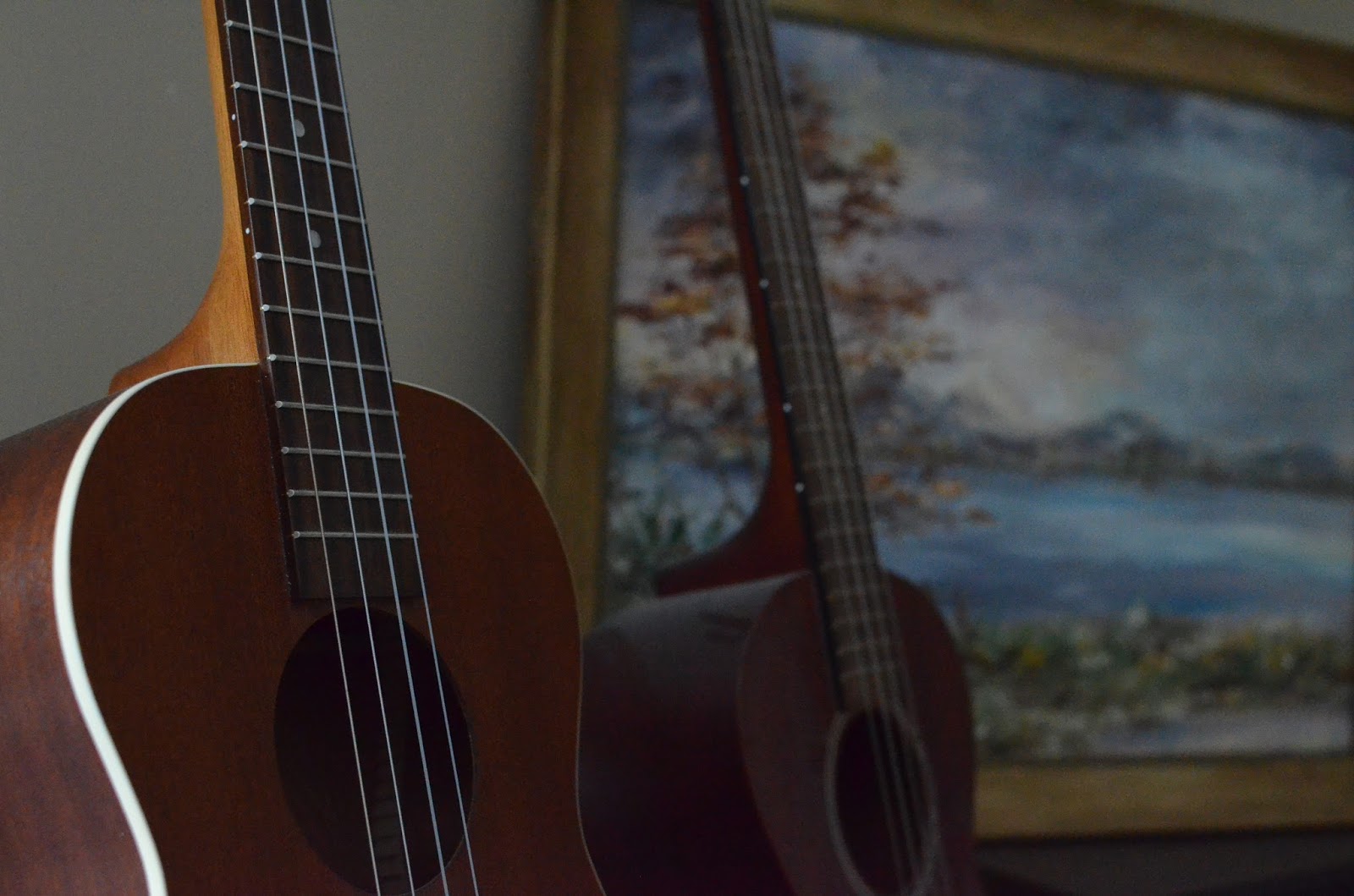
Here I put three objects in order (the second is pretty dusty), and used approximately the same depth of field as the previous two images. My desk was getting boring, so...to a bookshelf for this one. The painting is from a local Ludington painter. My Grandpa and Grandma Split had it in their home.

Taken 12/29/14 at 6:43PM EST
F-stop: f/1.8
Exposure time: 1/80 seconds
ISO: 6400
Auto white balance, auto ISO
with Nikon D7000 body and Nikon 35mm f/1.8G AF-S DX Lens
I stopped down to f/1.8 for this one on account of low light. The vantage point is from my desk into my neighbor's backyard. There is a little bit of orange light from across the street that gets blurred through the screen. Of the series of shutter speeds and apertures I took, this most accurately described the mood of my room at the time.