Saturday, June 02, 2018

An emphatic no

Will Calvin be a Comprehensive Liberal Arts College or a Liberal Arts University?

This question was being considered at a panel discussion I attended last fall, and questions were being asked as to the questions we should ask when considering such a question. Ha! I know.

In the time between when I started this post and its publication the question has been answered: yes.

I concede that this question is relevant, valuable, and necessary to consider for the health of Calvin as it continues into the 21st century.

As an engineer I scream: "Calvin should not be a Liberal Arts University!!!!*"

*whatever L.A.U. means, and however you define it, which is still being worked out in earnest

Perhaps there is room for compromise: "engineering at Calvin should not be expected to expand into an R1 mode!!!!"

It feels like I'm deflecting from the question at hand, however I think the case of engineering maps reasonably well to the rest of the departments at Calvin.

Our engineering department is great at many things. We have dedicated, knowledgeable teachers who come from diverse industrial and academic backgrounds and disciplines. These women and men care deeply about engineering, love the discipline, and care for the health and edification of their students--faculty at R1 institutions also care deeply about their students, however their primary focus in many cases is facilitating excellent research programs, which is a beneficial yet fundamentally different aspect of education and the academy. The primary focus for Calvin faculty is not on grant applications and research program direction.

It's not about being approachable (the doors to faculty offices at R1's are open to students), but rather has to do with the focus of the faculty. Intention gets you far, but purpose is at the heart of Calvin's devotion to equipping students (recite it with me! with gusto!) to think deeply, to act justly, and to live wholeheartedly as Christ's agents of renewal in the world.

I loved the time I spent in graduate study at an R1 institution. It gave me an enormous appreciation for R1 institutions, and more so for the engineering program at Calvin College.

As a TA in engineering, it was clear that while undergraduate students were to be cared for, research was the focus and the important factor. I have never felt this sentiment at Calvin while as a student, nor while as a member of the teaching staff. We do excellent research here--it remains student-focused.

Calvin is good at letting students do any and all of the things they desire (though it may take a bit of time) because Calvin is hyper-permeable. Debra Rienstra, of the english department, made a great point about permeability in education, and allowing students the option to passionately study engineering and music, for example. This is so easy to do at Calvin--talented students do it often.

Personally I was able to pursue both chemical engineering and chemistry majors (a pairing that dovetails almost too easily) and felt integrated and welcomed in the chemistry department though my degree would ultimately be in engineering. I also personally know many students who have combined music with engineering, or public health, or literature--permeability!

The matter of purposeful student development is of real practical meaning and action to me. I taught at Calvin for a few years now and have found renewed purpose and academic redemption of sorts.

So what does Calvin gain? An excerpt from the official press release:
Le Roy says the rationale for Calvin becoming a university is strong, including Calvin’s strength, breadth, and depth of its academic programs; new opportunities for academic innovation; and the college’s increasing influence with students and higher education partners around the globe. The college also has a large international student population for whom “university” is more visible and better understood than “college.”
Calvin leaders also see the university structure combined with increased collaboration as creating a more prominent platform for the institution to express its mission through opportunities and innovation within and across disciplines, professional programs, and centers and institutes.

“A move to a university with a liberal arts foundation both names what we already do and liberates us to do that work better,” said Kevin den Dulk, political science professor at Calvin College and executive director of the Henry Institute. “I’m especially enthusiastic about using the university structure to expand our global reach, which is already considerable yet has a lot of room to grow.”
The bulk of the argument seems to hinge on recognition from international students. I understand the idea that with declining domestic enrollment, it will be key to bolster international recruitment and admissions. But surely reputation and name recognition go beyond the distinction between 'university' and 'college.' Are we now relying on a prospective student or parent to perk up at reading 'Calvin University' on print material, when 'Calvin College' would have caused them to merely gloss over it and move on? This is a weak premise to hang our hat on. Since I've heard 'international recognition' repeated more than almost any other talking point, I don't think this is a mischaracterization.

I truly don't see what the university structure of colleges versus departments will do to facilitate "increased collaboration" and innovation. Innovation and cross department collaboration have been happening for years: ISRx a project melding biology and chemistry departments, and the various interims and summer programs that unite business, engineering, and german programs are two prominent examples that have paid enormous dividends for the departments in question.

Finally let's consider the professional programs. From the standpoint of engineering, I just don't see where the funding is going to come from to provide for post-baccalaureate educational opportunities. Our engineering building is already at capacity hosting senior design team efforts. Where are the research facilities going to appear from for students to do thesis research on one or two year master of engineering programs? Where is the lab space going to open up for chemistry or biology PhD work? No one is arguing for an immediate ascent to R1 status of course, but I also haven't seen a coherent vision of what Calvin University will mean for the different departments/colleges. Certainly such a vision would not need to be set in stone, but I haven't heard even a whiff of a plan for my department, and that concerns me.

Calvin seems to be doing just fine without a 'university structure.' I truly hope that this choice was not made for feathering caps, and prestige.

We'll see what visions develop.

Wednesday, October 04, 2017

Civic engagement

After a conversation with friends last week, I decided to take action in a simple, thoughtful way.

We were talking about the cost of education, and the kinds of tax breaks you can expect to receive based on the interest you're paying on student loans--the best you can do is to deduct $2,500 of the money you pay in interest on them. It's not a credit.

And at this point, we're not even talking about the possibility of paying a mortgage if you want to own a house. At least with a house you can deduct all of your interest payments...

That seemed woefully inadequate to me, so I wrote this up in a couple hours on a Friday afternoon. Feel free to peruse, use, wholesale copy, or otherwise, and send to your representative and senators if you feel so inclined. Maybe make a call or visit an office.

I did so this week.

Has anyone else done something similar lately? The benefit of having a madman trying to run the nation is that civic engagement seems up.

Monday, March 20, 2017

I believe...[work in progress]

God exists

-[this is the critical, frustrating point that I will never be able to prove, and will honestly, probably always feel uncertain about]

-if I accept that, then the Bible relates that:

--Jesus is the son of God, who came into time and space

--Jesus sacrificed union/love/relationship with the Father on our behalf in a singular way

--we choose to distance ourselves from God in sin

--the penalty for sin is its fulfillment--separation, probably eternal--practically I don't know what that means

--Jesus gives us life freely

--the kingdom of God is greater than my salvation

--the work of the church is to bring the kingdom of God on earth--this happens in sometime conflicting and inconsistent ways (see the Bible)

-the Bible is the story of God's people (in part descriptive, prescriptive, and corrective)--it's God's word, but it is not the Word, nor is it God

--in the Beatitudes Jesus turns power on its head and shows his kingdom priorities

--Parables of the Kingdom tell us how Jesus thought of what was to come:
---the parable of the weeds says that God acknowledges human suffering and strife before his coming Kingdom
---the parable of the sower says that it is difficult to follow Jesus; it is difficult to have faith even; the Gospel of Jesus produces real change in people
---the parable of the hidden treasure describes the way a person gladly gives up his life and possessions, in a way that may be impossible to understand, in order to gain an even more precious way of life
---the parable of the pearl, in a similar way tells of the value of the Kingdom of heaven--worth more than any current power
---the parable of the growing seed reassures those tasked with Kingdom building that their labor is not in vain--a new thing is growing
---the parable of the mustard seed describes the extent and breadth of the pervasive Kingdom
---the parable of the leaven tells of how the Kingdom of God is inevitable after introduction of yeast--surely the resurrection of Jesus

-Jesus is the best thing for everyone because his resurrection is the preview of God's plan for a kingdom made right

-our fellow man deserve love not because they are objects to be converted, but because they are loved by the creator as much as I am

-faith is mysterious and maddening--sometimes I hate it

Tuesday, December 27, 2016

Birds eat grass

I'm expectant and bubbling--effervescent and impatient.

The semester is over. I've graded the students; I've graded the course & myself.

Work continues such as it is. Folks & products are heated & cooled. Oil lubricates and is washed away.

But I. I sit on the edge of a precipice.

It might not be a precipice (do my legs stretch before me in the dirt?)--I might be poised above four blades of browning grass.

Or. Or I might be clawing for air: a fledgling.

Tuesday, November 22, 2016

The idolatry of power

More than anything else, the election in 2016 has been a mirror, showing me what I naïve fool I've been.

I'm going to preface what I say next with three important statements...
I think it is possible to have voted for Donald Trump as a Christian.
I think it is possible to have voted for Hillary Clinton as a Christian.
I think it is possible to have voted for a third party candidate as a Christian.
My naïveté comes from expecting that the white, Christian, evangelical church* would live beyond politics--that is, biblically contextualize them within the Christian life [*note: the CRC is evangelical, a member of the National Association of Evangelicals (NAE)].

I was a fool to think that the Church would be honest with its poorness of spirit and need for the gospel. I was a fool to think Christians would embrace the way Jesus turned human politics on its head. Evangelicals have demanded a modern Saul as their king [1 Samuel 8]. Saul is who they have received.

In past elections the "religious right" have voted for Mitt Romney due to their embrace of family values (likely because they were uncomfortable with the idea of a Mormon in the White House--considered by the CRC to be a cult). Family values means: opposed to rights for LGBTQ citizens and an anti-abortion stance.

Overwhelming support of Donald Trump by evangelicals (81%) is the most recent symptom. It is remarkable, that for so many "liking neither candidate" (a common refrain), they came out in record numbers for a Social Darwinist candidate. This is greater than support for Bush, McCain, or Romney--typical Christian-backed candidates.

I can't take the "liking neither candidate" statement seriously, because the truth is Christians voted for a man that denigrated minorities, women again & again, his fellow GOP hopefuls, the disabled, and military heroes.
Many had no problem calling a professed Methodist evil.
They might have honestly believed that, but I think the real reason is that faith in conservatism and liberalism shone through. Evangelical Christians trusted their parties and political ideology more than they did their Jesus and his message.

Many high-profile Christians did.
Some went as far as Wayne Grudem: "now that Trump has won the GOP nomination, I think voting for Trump is a morally good choice."
Pat Robertson dismissed Trump's comments about grabbing women as "macho talk".
Jerry Falwell Jr. endorsed Trump and said “Five years from now when we’re sitting here and we see all the Constitution being ripped apart by justices (appointed by Clinton), nobody is going to remember what horrible things Donald Trump said over a decade ago,” and in the same convocation, Ralph Reed pointed to abortion as the “defining moral issue of our time,” saying Trump is “running on the most pro-life platform in the history of the Republican Party.”
Franklin Graham has made comments that "the godless progressive agenda of Barack Obama and Hillary Clinton likewise cannot be defended. I am not endorsing any candidates in this election" then goes on to say that the future Supreme Court appointees are the most important issue of the election.
James Dobson is a one issue voter: anti-abortion.

A prominent theologian, Miroslav Volf, did come out for Clinton (with reservations): "The best case to be made for Hillary Clinton is that on balance she better represents the convictions and character that should concern Christian citizens. No candidate is perfect."

Christianity Today polled a very curious number, which seems to explain the shift we saw: evangelicals shedding their concern with moral authority and Christian witness.
Q: Can elected officials behave ethically and fulfill their public duties even if they have committed immoral acts in their personal life?
30% of self-identified white evangelicals said yes in 2011
72% said yes in 2016
To move from 30% to 72% in four years is a remarkable pivot--a pivot that essentially supports conservatism, and an anti-abortion stance as the most important issue facing the world and the church.

Choosing to stake that claim on a candidate like Trump with a precarious position on abortion baffles me.

I understand that many Christians (and Americans in general) feel they weren't being listened to--the Democratic Party did an abysmal job of this: they catered to centrist, elitist, imperialist positions.

1) the Sanders campaign was shoved aside in favor of what party leadership wanted
2) the perspective of middle America (and perhaps evangelical America) was ignored: factory jobs lost due to globalization, facing stagnant wages

Clearly there was a gross failing in the Democratic party to reflect and represent its constituency (I wrote about my distaste for Clinton's position previously). It remains to be seen if the party will recover.

However...the fact that evangelicals are defending Donald Trump, or even happily joining the "Trump Train" still beguiles me. Christians are certainly meant to engage with politics, as citizens building God's kingdom now, but what that looks like allied with Trump is unclear.

As he fills cabinet positions, being praised by the alt-Right (literal neo-Nazis), I don't hear concern from conservative Christians. I don't hear anything at all [note: as of 2:30pm 22Nov16, Trump has disavowed "the alt-Right"].

What I have seen are Christians who I once thought respected me, label non-conservative Christians as "sad" people, and others claim victory for the church with a Trump win.
It's one thing to support a candidate--another entirely to be honest with who they are and the extent to which they deserve support and criticism.

I can't speak for anyone else, but for my own part I want the world to easily identify me as a Christian & kingdom builder, and wonder briefly about my politics. I don't intend to be a modern Sadducee.

I'll leave you with this out-shot to think about, from a post written four years ago in response to the Obama-Romney race:
Pastors will have to ensure congregations know right doctrine—a desperate need for this generation of Christians in any case. Individual Christian voters will need to distinguish, perhaps publicly, between their vote for the politician and their fierce disagreement with that politician's beliefs.
// Stephen Mansfield

Wednesday, September 28, 2016

The dark side of Clinton's American exceptionalism

Hillary Clinton is an imperialist and hawk, comfortable with the use of American force abroad.

Though perhaps not as strongly as others, she embraces American exceptionalism, defined either as America's superiority over other nations, or as America's unique ability or charge to change the world.

Great empires the world over have viewed themselves as exceptional--from Imperial China to Britain. That re-purposed narrative rings tired to me. America's foundation and rise in influence are perhaps singular, but to take that as a divine mandate is folly*.

In our nation's history, this view has resulted in such conflicts as Vietnam, Iraq, and Afghanistan.

As Secretary of State, Clinton supported the United States-Colombia Free Trade Agreement--passed by Congress in 2011 and set in motion during President Bush's second term in 2007. Her stance on trade has of course changed over time. In 2008 she opposed it, citing "the history of violence against trade unionists in Colombia," which is turning out to be a very real concern.

The agreement is meant to:
"...expand U.S. goods exports alone by more than $1.1 billion and give key U.S. goods and services duty free access in sectors from manufacturing to agriculture. It will increase U.S. GDP by $2.5 billion and support thousands of additional U.S. jobs."
While it hasn't been covered in great depth by mainstream news sources, Daniel J. Camacho, a scholar at Duke (and Calvin grad) who I follow on Twitter, has been an outspoken critic of the Free Trade Agreement and Clinton's involvement:


In a well-reported piece by the Nation, Michael Norby and Brian Fitzpatrick delve into the internal refugee crisis in rural Colombia, exacerbated by the agreement. The country is one of the most dangerous in the world for union members, with ITUC reporting:
"that thirty-five unionists were murdered in Colombia in 2012, solidifying the country’s status as the most dangerous place on earth to be a union member. Between 3,000 and 4,000 Colombian unionists have been killed since the late 1980s."
Criticism of American exceptionalism is clearly not popular. It's even touted in the first line of the 2016 GOP Platform: "We believe in American exceptionalism."

But that doesn't make it right, and that doesn't make us, as a nation, above reproach.

The reason this hasn't seen more coverage is that both major parties are complicit. The U-CFTA has been a bipartisan effort, passed under the Obama administration, but since it benefits American exports, no one is saying anything.

Clinton deserves criticism on this. We are better than this. If we truly are exceptional, we can show it by engaging in trade agreements that are fair and just to both nations, and that don't leave the poor in a state of dire marginalization and violence.

I'll leave you with one of Daniel's tweets:

*I'm proud to be an American, but to say that we are inherently different from other nations is hubris.

Friday, September 23, 2016

Political correctness or dignity (and whiteness)?

If you listen or read anything remotely related to political matters in the United States (or probably elsewhere), you will have heard the term 'political correctness.'

The trend lately is to decry what is seen as overly politically correct speech, used by candidates or officials.

Recently in an Esquire interview, Clint Eastwood has praised Presidential candidate, Donald Trump and ranted about political correctness:

"Because secretly everybody's getting tired of political correctness, kissing up. That's the kiss-a-- generation we're in right now. We're really in a p---- generation."

"Everybody's walking on eggshells. We see people accusing people of being racist and all kinds of stuff. When I grew up, those things weren't called racist."
I'm not sure who 'everybody' is. More troubling though, I am not sure the use of 'political correctness' isn't meiotic, a stand-in for something more sinister--in this case I'm speaking specifically about race in response to Eastwood's comments, though the implications reverberate broadly (see note at the end).

In a way, push-back against political correctness definitely sounds better than push back against 'the Golden Rule.' The GR, in the words of Jesus (Matthew 7:12):

In everything, treat others as you would want them to treat you, for this fulfills the law and the prophets.
I want to be able to tell my own story, in my own terms--allowing that I am honest with myself, most people would agree to this plea because most desire it for themselves (the degree to which you are allowed that chance by others is directly related to how much they trust your version of things).

White people have always been able to frame discussions and terms used to describe White people--historically we've also been free to describe any other race and frame class discussions without fear of repercussion or consequence.


A side note to make this point: consider the picture you have in your mind of 'White people.' I immediately envision a White middle class family with a house and yard in the suburbs--a class specific image that doesn't paint the whole picture. It doesn't describe poor Whites in any number of locales, or the super rich either. The class we each come from and belong to frames the way we generalize about groups. Class provides enormous power when it comes to description--like it or not, the classes with more money (power) are afforded the privilege of enhanced perceived credibility (the same goes for level of education).


Going back to my point about who is allowed to frame discussions and terms: White people. Historically the locus of power has been with White people (slavery & reconstruction via Jim Crow, Native American reservations, Chinese laborer immigration restrictions, Japanese American internment camps) and non-Whites have paid the price (even the term non-White does this! It frames a White-centric perspective.).


The locus of power does not lie merely with martial or political power however. It lies with who is able to control dissemination of communication (look at how Republicans and Democrats have partisan language patterns--it's important!).


Lately you hear talk about how great things used to be. People describe wanting to go back to something that has apparently been changed.


I think I know what's changed. I don't think it's because violent crime is on the rise (it's on the decline) and I don't think it's because people are "race baiting," whatever you think that term means.


I think it's because White people are hearing Black voices (and of other people of color), and they don't like it, and they aren't used to it, and they want it to stop because it makes them uncomfortable (I had the same experience before I thought about why I felt that way). It's likely due to the expansion of social media platforms and coverage of the 24 hour news cycle. Black voices can be unsettling to the concept of whiteness (see reading resources below) particularly when we're used to information that has been sanitized in some way by Whites (how would a White person like it to sound?).


The #BlackLivesMatter movement and Civil Rights movement are prime examples of this.


Let's address the Civil Rights movement. Dr. King's Letter From a Birmingham Jail is a direct response to White clergy who were convinced that the ongoing demonstrations were "unwise and untimely" (let's wait for all the facts, don't be hasty). Black people were demonstrating and resisting and doing their own thing to advance justice. White clergy (and White Christianity) were threatened by this.


Today, when people make the statement that "Black lives matter," they are immediately met with resistance, in the form of "all lives matter"--as if that statement needed to be said. White people don't like the sound of "Black lives matter." It makes us uncomfortable, not because we don't think it's true, but because it is not a White-centric message. Sure, White voices like mine feel comfortable saying it, but many Whites don't feel comfortable hearing it.


A Black voice said it originally, and Black and White voices continue to echo it.


It's like Broderick Greer (an Episcopal priest I follow on Twitter) says repeatedly:


We Whites are used to treating others like WE want them to be treated, with OUR voices.

We Whites are seeing push-back by other groups, increasingly being able to define terms and rescue/create dignity by being called what they want to be called.


Some of the power being given up by Whites via the dismantling of 'whiteness' is the ability to, with comfort, ignore 'the Platinum Rule': treat others like THEY want to be treated. We don't like the loss--it feels like people of color are being overly sensitive, when really they just want the dignity of telling their own story with their own words.


--


If you want to tell me I'm racist for writing this, here are a couple steps:


1) Read the resources on 'whiteness' below.

2) It's not racist or 'race baiting' to talk about matters of race.
3) If you disagree with the concept of 'whiteness' the burden of proof is on you, because there is significant scholarship to support it.
4) Ok, having done that, describe how I'm racist, and give some support for your argument.
5) Cool. Thanks. I'm racist.

Resources:

Constructing Whiteness by Judy Helfand
Trump Reflects White Male Fragility by Charles M. Blow
What is Whiteness by Nell Irvin Painter
Summary of Whiteness Theory by Audrey Thompson

Note: the idea of political correctness or dignity is directly applicable to how different groups frame the discussion around the rights of LGBTQ individuals as well.

I've heard descriptions such as "tranny, he-she, it, shemale, transvestite, man in a dress, hermaphrodite, or freak." Those slurs are meant to strip dignity and wound. There is no other reason for them.
For some, these might not be slurs, but for the people in the video, they are, and they hurt. The point is not which specific words can or can't, should or shouldn't be said, it's about treating people how they want to be treated.

It's a choice to use language that conveys dignity--when you choose to "not be politically correct," know that what you're doing is intentionally stripping dignity from a group or person, nothing more, nothing less.

Even if someone's identity makes you uncomfortable, you can still treat them as a person--you're the only one who needs to come to terms with your discomfort.

Monday, August 15, 2016

List of things that are Obari as hell


My friends
Gardens full of tomatoes & squash & asparagus
Books
Hammocks (eno obv)
Thermodynamics
Tennis with my brother
Coffee in the morning
Coffee at noon
Coffee in the evening
Tea any time
Backpacking
Ukuleles
Bicycles
Chemical kinetics
Tonka pies
Rhubarb cake
Rhuberry bluebarb jam
Mass, heat, and momentum transport
The conservation laws
Lagers
Kölschs
Sour beers
Red wine
Deutsch
Fried okra
Nelly

Wednesday, July 20, 2016

My top 10 favorite rappers/MCs/DJs

Links are to youtube or vimeo (*cough* Jay-Z on Tidal *cough*).
They're mostly NSFW lyrically.

In no particular numerical order, except via tiers:

S
1. Biggie
2. Gift of Gab
3. Q-Tip and Phife Dawg
4. Rakim

S-
5. Nas
6. Killer Mike
7. Jay-Z
8. Nelly
9. André 3000

A
10. Tupac
11. Nicki Minaj
12. Lil Wayne
13. Boots Riley
14. Eminem

I'll recognize the unquestionable brilliance of others such as Mike Shinoda too. I like Linkin Park and Fort Minor, sue me.

This list brought to you because I just watched Lin-Manuel Miranda do his top 5.

The criterion was personal preference, lyricism, and sound (generally). I concede my taste is confusing, inconsistent, questionably informed, and ordered unconventionally. I'm a fan not a head and I can't speak very intelligently about hip hop but I've had many good recs from my friend Dan Lee and Jesse Thorn (Bullseye).

Updated 29JUL2026.

Thursday, July 07, 2016

Hey White People!

Black fathers, mothers, daughters, and sons are being murdered.

The state is essentially sanctioning these lynchings, and you aren't saying much of anything.

What many of you ARE saying is that "all lives matter," or looking for justification for the murders.

The rest of you aren't saying anything at all. You're posting about the fourth of July, or about emails that should have been more secured. Maybe you don't like to "get political."

It's fine to not get political if you're white, because you can afford to. This political cycle won't change much for you. You'll complain about Trump or Clinton for a few years.

Everything is political for black people; they have no choice, because they are dying at the hands of the state. They are dying for no reason, in most cases innocent. In the case of allegations, they are being executed instead of receiving trial.

I'm not choosing to write this because I'm a conservative or a liberal. I'm writing this because people are dying and few of my white friends are saying anything at all. My black friends are saying plenty, but I'm not convinced you're listening.

All lives won't matter until black lives matter, so save that s*** for another day. I chose to use that crass word, because it speaks to the nature of the "all lives matter" statement.

ALM is willful ignorance and white silencing of the devastation and horror that black families feel when their fathers, mothers, sons, and daughters are killed at the hands of those supposed to be protecting them. No one disputes that life matters. It's in our Declaration of Independence. We get it. It's supposed to matter.

I'm not blaming you or myself for hating black people, because most of you DON'T.

I'm not blaming you for anything.

But if you stay silent now, or the next time, or refuse to LISTEN and LEARN and EDUCATE yourselves, you are becoming complicit. Your silence is deafening. And that is worthy of blame.

Wednesday, June 29, 2016

Conservatism & Liberalism & civility

Liberalism and conservatism are tools.

Each ideology is inherently at odds with the other. They are not moral opposites (rather amoral), but are opposing systems of thought. Let's lay each of them out.

Liberalism, highlighted:

John Locke, the father of liberalism, regarded

     religious tolerance,
[separation of church and state due to the fallibility of man, and the idea that belief cannot be compelled by violence]
     private property,
[a natural right determined by the use of labor to produce goods or property, which PRECEDES government*]
               and

     opposition to the divine right of kings (tyrannical rule),
[the will of the people gives authority to the government]
as important philosophical tenets. These among others, such as liberty and equality, underpin theories of liberalism and the very foundation of the American experiment--they directly inspire the Declaration of Independence and the American Constitution.

Necessarily distinct from broader liberalism, modern American liberalism has generally come in the form of protecting citizens from economic oligarchy, as opposed to monarchy in most of the rest of the world, for obvious reasons (the American Revolution was a liberal event in the context of monarchy). Application of rights to Americans has broadened since 1788/1791 to include poor white men, women, black people, and as of late, LGBT citizens--essentially liberal developments.

Paul Starr, American professor and co-founder of liberal magazine the American Prospect, in 2007:
"Liberalism wagers that a state... can be strong but constrained—strong because constrained.... Rights to education and other requirements for human development and security aim to advance the opportunity and personal dignity of minorities and to promote a creative and productive society. To guarantee those rights, liberals have supported a wider social and economic role for the state, counterbalanced by more robust guarantees of civil liberties and a wider social system of checks and balances anchored in an independent press and pluralistic society."
Generally this agrees with liberalism as politics of liberty and equality--in a matter of speaking:
developing the common good advances the freedom of the individual.

Conservatism, highlighted:

In 1959 Quintin Hogg, chairman of the British Conservative party, wrote in his book The Conservative Case, that:
"Conservatism is not so much a philosophy as an attitude, a constant force, performing a timeless function in the development of a free society, and corresponding to a deep and permanent requirement of human nature itself."
If you take Hogg's statement, the conclusion has to be that this attitude depends precisely on the current state of affairs, to which conservatism is a response. Conservatism is a necessary force, a pull, that helps society determine if the strides we are making are good and merited.

American conservatism is a different entity--one based in historical context and current social forces.

William F. Buckley Jr., American author and conservative voice:
"Among our convictions:
It is the job of centralized government (in peacetime) to protect its citizens' lives, liberty and property. All other activities of government tend to diminish freedom and hamper progress. The growth of government (the dominant social feature of this century) must be fought relentlessly. In this great social conflict of the era, we are, without reservations, on the libertarian side. The profound crisis of our era is, in essence, the conflict between the Social Engineers, who seek to adjust mankind to conform with scientific utopias, and the disciples of Truth, who defend the organic moral order. We believe that truth is neither arrived at nor illuminated by monitoring election results, binding though these are for other purposes, but by other means, including a study of human experience. On this point we are, without reservations, on the conservative side."
Buckley acknowledges that his second and third sentences are remarkably libertarian--then makes an interesting judgment concerning "Social Engineers" meaning liberals, and the conservative "disciples of Truth," defending order. This is the crux of what it means to be conservative in any context.

Current American conservatives sail by the prevailing winds of tax-cuts, increased military spending, family values, deregulation, and smaller government. Much in the same way that modern American liberalism draws from Roosevelt's New Deal and Johnson's Great Society, these Reagan era ideals generally describe what it is to be conservative in America today.

--
Let's go back briefly to what Buckley said in his first sentence. He reminds us that government is meant to "protect its citizens' lives, liberty and property." It's rather a curiously liberal statement, one with which Locke, the father of liberalism would agree.

This reinforces the story of liberalism and conservatism as opposing forces relative to their time. Civilization has come a long way since the 17th century--today, Locke would be surprised at how liberal the conservatives in America tend to be. I don't say that as an insult or a jab. Scholars say the same.
Leo Ribuffo, American historian, in his book Historically Speaking:
"what Americans now call conservatism much of the world calls liberalism or neoliberalism."
What better way to explore this tension than through the politics of Abraham Lincoln, first elected President for the Republican party, a man claimed by both modern Republicans and modern Democrats (for good reason)?

The Lincoln case study:
In 1859, Lincoln regarding conservatism in the United States (pg 35):
"The chief and real purpose of the Republican party is eminently conservative. It proposes nothing save and except to restore this government to its original tone in regard to this element of slavery, and there to maintain it, looking for no further change in reference to it than that which the original framers of the Government themselves expected and looked forward to."
Lincoln hearkens back to the spirit of the Founding Fathers, yet later he issues the Emancipation Proclamation, a profoundly self-contradictory and liberal act.

On one hand, it led to a very progressive expansion of rights for slaves, but on the other, it displayed a carelessness toward the Constitution via Lincoln's assumption of powers ("unilateral decision to call out the militia to suppress the "insurrection," impose a blockade of southern ports, expand the army beyond the limits set by law, spend federal funds without prior congressional authorization, and suspend the writ of habeas corpus" [source]) for which he was heavily criticized by Democrats.

Like the Founding Fathers he was a classic liberal, but not in the sense that we describe liberals today. To do much of what he did, Lincoln needed, and used (though vehemently protested by many) a strong federal government and its powers, yet described himself as a conservative (as defined at the time).

He is neither a modern conservative nor liberal, rather some amalgam.
That amalgam successfully held the Union together, and simultaneously phased out slavery (which the Founding Fathers expected would wane, gradually wither, and die).

You can look at Lincoln as having a sort of internal bipartisanship, a sort of effective cognitive dissonance.

--
Liberalism and conservatism in America have many points of conflict, as well as points of commonality. They are ways for our society to decide how we want to be governed and how we want to BUILD a greater nation.
Yet, often we squabble about politicians being too this or too that; we're concerned less with WHAT we are building, as with WHO is building it and how offended we are by them, or how well they're liked. The Founding Fathers weren't exactly a basket of peaches, but their ideas were effective and visionary--the ideas are the point.

Focus on political identity, unwavering stances, and bombastic speech, rather than movement forward to build a better system, polarizes and paralyzes American politics.
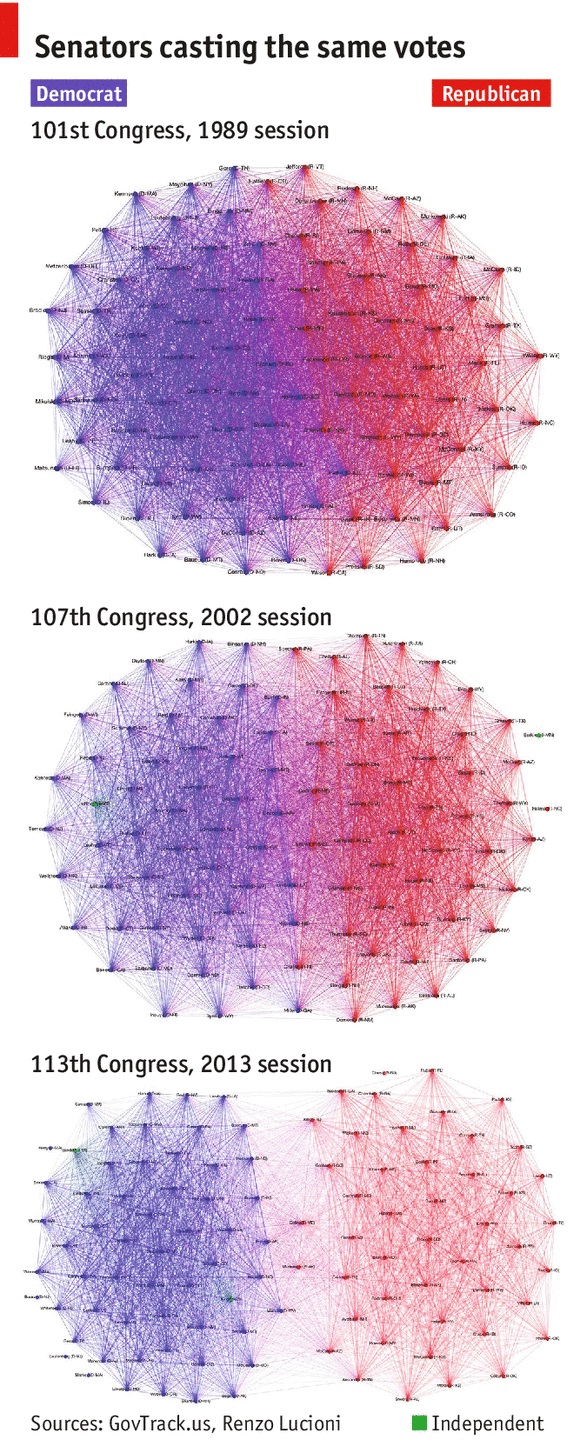
The Economist reported on a chart generated by Renzo Lucioni, a computer science student, that illustrates via similar voting habits, how bipartisanship has eroded in the Senate from 1989 to 2013.
It's not surprising, but it is worrisome.

Pew Research Center has concluded that while a more significant portion of Americans today tend to be consistently liberal or consistently conservative, the groups that comprise the middle are:
"...a combination of groups, each with their own mix of political values, often held just as strongly as those on the left and the right, but just not organized in consistently liberal or conservative terms. Taken together, this “center” looks like it is halfway between the partisan wings. But when disaggregated, it becomes clear that there are many distinct voices in the center, often with as little in common with each other as with those who are on the left and the right."
This would be good news if we had a mixed-member proportional representation like Germany (1949 at inception) or New Zealand (1994 after electoral reform), but with our two party system, there is very little incentive to vote for a smaller party, which means that the smaller parties have very little opportunity to contribute to decision making at any level, much less national or as part of a coalition.
Over time this has led to more polarized identity-politics, and the emergence of groups like the Tea Party which insist on radical commitment to principles that are pseudo-Republican, branding as traitors those who are not conservative enough.

That being said, there isn't a right or wrong party.
Truths**:
1) You can care about science and facts as a conservative or liberal
2) You can be highly educated, and value it, as a conservative or liberal
3) You can care about the plight of the poor as a conservative or liberal
4) You can be the civil opposition as a liberal
5) You can be the civil opposition as a conservative
6) You do not have to hate conservatives to be a liberal
7) You do not have to hate liberals to be a conservative
8) #6 and #7 each bear repeating...
The reality is that we have two political parties and their members in our legislature are tasked with representing a constituency that is often uniformed on subtleties of ideology, and who on both sides sometimes refuse to do the hard work of being informed.
I too am a complicit member of this electorate.

Do we look to members of another party and choose to simply throw cheap shots, mud-sling, character-condemn & -disparage, or do we choose to actually acknowledge the differences and how they can be reconciled or used to compromise, and build a better version of America?

It is SO† much easier to ham-fistedly and self-righteously scream and argue a point (being unwilling to concede an INCH†), than to consider, reconsider with good information, then work toward a solution that honors conservatism and liberalism (or libertarianism) as guiding principles‡.

Please choose to do the latter. It's how America was built.

--SP
------------------------------------------

*Note: Locke however "implies that government would function to moderate the conflict between the unlimited accumulation of property and a more nearly equal distribution of wealth; he does not identify which principles that government should apply to solve this problem." This is a very important point, as we live in an age where political monarchy have been replaced by economic monarchy.
**Borrowed in part from Aaron Sorkin's the Newsroom on HBO. It's worth a watch. Seriously.
†Note: this indicates that I am actually mad at the time of writing. HAVE SOME HUMILITY, PEOPLE!!
‡See Federalists vs Anti Federalists debate on Constitutional ratification.

Thursday, June 16, 2016

One last Hamilton gush

Look. I've been listening to the soundtrack of Hamilton for weeks, after my friend Courtney eventually got through to me and INSISTED for reals that I check it out.

Finally, a few minutes ago, I took a moment to watch a bit from the Tony Awards. Blown. Away.

Get. It.

Note, not to be confused with the Hamiltonian. Or Hamilton, Ian. Words are fun. So says Lin-Manuel.

Tuesday, June 14, 2016

Are you not entertained?

Nearly any good thing can be made into a tool.

Companies and governments excel at making malevolent tools of people and things--even good ones.

In the United States, we have elections every four years for the Executive Branch of government. What a great blessing and system! It proved initially that power could be handed peacefully and consistently between free groups with different ideas about how to run a nation.

It still does that. Our democracy is, in many ways, a model for democracy around the globe.

However, it is also a model for vitriol and polarization and alienation. Our politicians have had dirty squabbles since the beginning--politics has never been a nice, kind process even in the United States (election of 1800).

Those bitter practices continue from 1800 to the present day. I don't see that changing. It's not even a terribly bad thing (even if things can get rather nasty).

My point though, is that because of these practices, we need to recognize that they can be used by outside forces, with identities that are not immediate apparent (or possibly well concealed).

Every four years, organizations, individuals, lobbies and others pump money into a media circus lead by individuals of varying decorum. Those individuals espouse a variety of positions, many of which are co-opted by party members (Democrats & Republicans; liberals & conservatives for the most part). Both of the two sides have good ideas as to the running of an efficient and effective government.

With that, a suggestion:

consider the positions you hold, in light of their counterparts or opposites.

1. Why do you hold that position?
2. Is it in line with the many other positions you hold, and the other creeds you profess?
3. Are you internally consistent as a person?
4. Do you want to be internally consistent?
    a. Why?
    b. Why not?
    c. What does that mean to me?
5. Where did you hear the information that lead you to your position?
6. Can you trust it?
    a. Why?
    b. Why not?
7. Who might have a stake in your current position?
    a. Might they abuse it?
    b. Might they have a nefarious reason?

Consider, reconsider.

Do you come to the same conclusion? Good, now you know why.
Do you come to a different conclusion? Good, now you know why.

Consider why you changed your mind...are you satisfied with why?

Oyyyy...keep on going, ad nauseam. I hope I don't grow tired of it though, and that you don't either.

Monday, June 06, 2016

Button, Founding Father


This is the level of Founding Father I aspire to.

Teaching recap // Spring 2016

My course evaluations arrived today.

An initial inspection would say I did better my second time around.
Alternatively, it could be because the students were better at problem solving after having already taken some 200 level engineering classes in the fall, or that my students didn't want me to feel bad, so they rated me better than I actually am.

This time around, the course practices that helped the students most were, in order:

1) Homework
2) Problems worked in class
3) Textbook
3) Lecture
5) Power Point slides
Basically, Lecture and PP slides flipped from last semester (Lecture took a big jump from 5th to tied 3rd!). That feels pretty good.

Course objectives were effectively the same as last semester as well as intellectual challenge, learning, and importance.

Some of the more helpful comments for improvement highlighted:
Didn't like the PP notes--too easy to glance over and ignore (preferred written notes)
Write bigger; explain more conceptual stuff first
Clearer PP slides
Less jargon in lectures; clarity in new concepts was hard at first
More examples (in-class, Moodle, etc.)
More engaging lectures; fix HW due dates
Work more steps in examples and write locations of tables
Keep teaching more; performance improved over the semester
Need experience teaching, controlling a classroom, and to be more confident (to give the impression that you're worth listening to)
Be more enthusiastic and awake

My apparent "effectiveness" rose from 2.66 to 3.15 from last semester. I was on the "good" side this time :)

The devotions via songs and cultural discernment remained popular.

Also, a few of my favorite comments regarding what the instructor could have done better to enhance learning:
N/A; you done good

He done good

Not a whole lot, 10/10 would recommend
Those were outliers; but nonetheless, they were heartwarming.

Upward and onward, better and better.

Thursday, June 02, 2016

the modern drivel machine

The truth is we're not all Thomas Paine...yet.

I suppose it should come as no surprise that with the advent of the Internet--the great facilitator of information sharing--a lot is being shared.

This seems to have directly contributed to the existence of virality. It's of course desirable to present your information to a large audience (even if only to sate the ego).

Companies and individuals strive to achieve larger and larger audiences. Anyone can have an opinion. Anyone can share said opinion on any number of platforms.

The opinions and arguments plugged into the network come from a very wide distribution of quality of course.

We're writing so much garbage, so many weak arguments, so much drivel. The good news is some of the garbage writing folks will improve their craft.

To them I say keep writing and improving. They give me hope. Those that recognize craft as a process that's never quite perfect (or even good) yet. In that way, this is the best time to write, since the printing press--for better or worse, we all have a shot. One day the fruits of practice and passion will flower and conceivably be called good, interesting, and worth reading.

Until then, continue eking verbal excrement. I know I do.

Wednesday, June 01, 2016

Startled by art

I had the opportunity to visit the Louvre in Paris, on the 23rd of May. It was packed--and actually pretty delightful despite that.

It was incredible to see classics like Venus de Milo, Winged Victory of Samothrace, Mona Lisa, and Coronation of Napoleon. They are all breathtaking (most pieces there are, to be honest--that level of skill is sooo outside my purview).

However, only two pieces truly caught my eye (...and possibly including Venus de Milo).

They are "Reine lagide en Isis: Cleopatre II ou III (?)" and "Peintre par elle même" by Louise Élisabeth Vigée LeBrun.

The first that caught my eye is a bust of unknown sculptor and year. I translated the inscription from French via GoogleTranslate:
Ptolemaic Queen Isis: Cleopatra II or III (?)
II century BC (?)
Marble
Cleopatra II, sister and wife, according to Egyptian royal tradition of Ptolemy VI and of Ptolemy VIII, lived 172 to 116 BC. His daughter Cleopatra III, sister and wife of Ptolemy VII, lived from 141 to 101 BC.
The long curls that frame the face are inspired hairstyles of the Egyptian goddess Isis. The royal banner here indicates that this is a sovereign figured in Isis rather than a representation of the goddess.
I think what drew me in is the curious expression on her face. It's like she's playfully (or actually) miffed by some remark, and subtly amused, while pretending not to be. At least that's my take. I really love this.

Edit: I was researching the sculpture later and found the French word volontaire used to describe it: determined. I concur. Perhaps both my description applies as well, though determined was probably what the sculptor was going for. It turns out she had a tough and (probably forced) incestuous life. I'd be pissed and determined too.

--          --          --          --
The second was a self-portrait of Vigée LeBrun with her daughter.

The inscription said simply that it was a self-portrait [Peintre (1755+1842) par elle même]. Wikipedia calls it "Self portrait with Her Daughter, 1789".
 I still can't quite put a finger on what I love about it--probably the tenderness and innocence. Both mother and daughter have eyes and facial expressions that are so completely evocative of contented love. I ordered a print of it today.
--          --          --          --
Before I visited the Louvre, my favorite pieces were by Salvadore Dali--Persistence of Memory in particular. 

LeBrun's self-portrait is my new favorite, followed by the Isis bust and finally Dali's crazy clocks.

[Image credits: Both photographs were taken by me, in the Louvre.]

Monday, May 09, 2016

You can't always get what you want


...but you just might find that you get what you need.

It's graduation season.

GVSU is already done, Calvin finishes up soon, Unity will be a little bit yet. Fine.

...but it's the Penn State graduations that are giving me intense, conflicting feelings.

This is the time and year that my cohort begins en masse to graduate with their PhDs.

I'm very happy for them and extremely proud of what they've accomplished. It's a big deal. They've done groundbreaking research that matters and have done it brilliantly, with excellence. They're the smartest, most resilient folks I know, and I miss them--they solved some intractable problems with patience and intelligence. Some of them have even been recognized by their government and by ChE's American Institute.

It's incredibly painful too though, because I also entered the program at the same time they did, with PhD aspirations. I earned my M.S. after three years and left almost two years ago. I left because I wasn't sure how much longer I'd be able to take the anger, coupled with verbal and emotional abuse, from my advisor. I was worried that it would affect who I was as a person and that was non-negotiable for me.

I'm not walking across a stage this month and no one will call me Dr. I won't lead a fancy pharmaceutical lab or drive a fancy car.

But I also don't wake  up with an immediate, deep sense of paralyzing dread every morning. I don't have to face the sneer of a supervisor who with every glance, breath and word tells you that you're scum and get different treatment. I don't have an eye tick from the stress of facing another human being.

Most days I'm very content to be doing what I'm doing--I love it in fact! It's the infrequent reminders that bring pain.

Naming the specific opportunities and good, good things in my life helps. I just re-read the documentation I made of my former supervisor's behavior for the first time in over a year--it was surprisingly helpful to remember the former days of insanity that I dealt with. I don't feel like a failure after reading it.

The beauty of the consolation prize M.S. that I earned (most days that's how it seems to me), is that I can teach college, and maybe even lead independent, novel research with undergraduate students in a new direction--one without the former baggage of a past research life. I can teach science to high school students and walk alongside others, talking about the things that matter. Even if a person decided that I wasn't worth their time, I learned the art of research and studied ChE with some of the best in my field--that can't be taken away.

Mine is not a prestigious life. But it's mine to give, and I'd rather give it to people who are deserving.

Saturday, April 09, 2016

Pharisees and periodic transcendental functions


I like functions, so after some thinking during Bible study a couple weeks ago, I came up with the above plot in Mathematica.

The Pharisees (a case study for humanity?) have years of Jewish history and culture framing their interpretation of what God, through the Law, called them to.

Jesus came and said, your initial conditions are right, but the human function caused a deviation from what God says the law means. He said that he was fulfilling the Law--pointing us again to closer communion with God.

We've had 2000 years from another set of conditions.

Maybe the church set a nice linear function for how we think about God, from the Law to Jesus, but we only ever had two points (arguably the Torah and Jesus' life--special revelation--though I don't mean to minimize general revelation, which I tend to celebrate as a scientist).

Sometime it feels like we're/(I'm) the Pharisees approximating God's higher order polynomial (or periodic, transcendental functions) with linear thinking and living. I usually find it's best to give up control over where we think God's Will is headed (because invariably I'm wrong or pigheaded), and recognize that Jesus told us to surrender our will.

Thursday, March 17, 2016

Thoughts on marriage and divorce from Matthew 19

I was reading Jesus' words in Matthew 19 about divorce and marriage for Bible study this week.

The disciples essentially ask, 'if divorce is not permissible, is it better not to marry at all?'

Jesus then makes a very wise point about approaching the marriage relationship. At first I thought he was making a value judgment, saying that if you can accept not marrying then you should--it's better to serve the kingdom than to marry.

However, I don't think this is the case. In verses 11 and 12, Jesus is saying that each person should be honest with themselves and discern if they are committed to marry or not, and if not, then make the decision to accept that.

This fits with the be fruitful and increase in number command from Genesis, but leaves a wide space for single people working for the kingdom. In a patriarchal society then, and now, this is counter-cultural. It liberates women (and men) from living within the framework of having value only when attached to a man (or woman).

It also puts the onus on Christians to consider carefully if they are committed to marriage.

Among believers this should be convicting--divorce rates are as high among Christians as non-Christians. Perhaps we do not properly consider the commitment as Jesus stated it. Perhaps we have been swayed by a cultural expectation and by patriarchy.

As a single person, I have no experience from the side of marriage--just my dating history. However, I can still see from this side that Jesus is emphasizing commitment in the marriage relationship. I have felt the pain of a breakup for just this reason.

Countless examples of family's and friends' marriages show that love in marriage is not easy. This truly underscores how critically important it is to understand that sort of love and what you are deciding to do when entering into marriage. The 'in sickness and health', 'hard times and easy times' phrases may be the most important in the vows that are commonly used.