Liberalism and conservatism are tools.
Each ideology is inherently at odds with the other. They are not moral opposites (rather amoral), but are opposing systems of thought.
Let's lay each of them out.
Liberalism, highlighted:
John Locke, the father of liberalism, regarded
religious tolerance,
[separation of church and state due to the fallibility of man, and the idea that belief cannot be compelled by violence]
private property,
[a natural right determined by the use of labor to produce goods or property, which PRECEDES government*]
and
opposition to the divine right of kings (tyrannical rule),
[the will of the people gives authority to the government]
as important philosophical tenets. These among others, such as
liberty and
equality, underpin theories of liberalism and the very foundation of the American experiment--they directly inspire the Declaration of Independence and the American Constitution.
Necessarily distinct from broader liberalism, modern
American liberalism has generally come in the form of protecting citizens from economic oligarchy, as opposed to monarchy in most of the rest of the world, for obvious reasons (the American Revolution was a liberal event in the
context of monarchy). Application of rights to Americans has broadened since
1788/
1791 to include poor white men, women, black people, and as of late, LGBT citizens--essentially liberal developments.
Paul Starr, American professor and co-founder of liberal magazine
the American Prospect, in 2007:
"Liberalism wagers that a state... can be strong but constrained—strong
because constrained.... Rights to education and other requirements for
human development and security aim to advance the opportunity and
personal dignity of minorities and to promote a creative and productive
society. To guarantee those rights, liberals have supported a wider
social and economic role for the state, counterbalanced by more robust
guarantees of civil liberties and a wider social system of checks and
balances anchored in an independent press and pluralistic society."
Generally this agrees with liberalism as politics of liberty and equality--in a matter of speaking:
developing the common good advances the freedom of the individual.
Conservatism, highlighted:
In 1959
Quintin Hogg, chairman of the British Conservative party,
wrote in his book
The Conservative Case, that:
"Conservatism is not so much a philosophy as an attitude, a constant
force, performing a timeless function in the development of a free
society, and corresponding to a deep and permanent requirement of human
nature itself."
If you take Hogg's statement, the conclusion has to be that this attitude depends precisely on the current state of affairs, to which conservatism is a response. Conservatism is a necessary force, a pull, that helps society determine if the strides we are making are good and merited.
American conservatism is a different entity--one based in historical context and current social forces.
William F. Buckley Jr., American author and conservative voice:
"Among our convictions:
It is the job of centralized government (in peacetime) to protect its
citizens' lives, liberty and property. All other activities of
government tend to diminish freedom and hamper progress. The growth of
government (the dominant social feature of this century) must be fought
relentlessly. In this great social conflict of the era, we are, without
reservations, on the libertarian side. The profound crisis of our era
is, in essence, the conflict between the Social Engineers, who seek to
adjust mankind to conform with scientific utopias, and the disciples of
Truth, who defend the organic moral order. We believe that truth is
neither arrived at nor illuminated by monitoring election results,
binding though these are for other purposes, but by other means,
including a study of human experience. On this point we are, without
reservations, on the conservative side."
Buckley acknowledges that his second and third sentences are remarkably libertarian--then makes an interesting judgment concerning "Social Engineers" meaning liberals, and the conservative "disciples of Truth," defending order. This is the crux of what it means to be conservative in any context.
Current American conservatives sail by the prevailing winds of tax-cuts, increased military spending, family values, deregulation, and smaller government. Much in the same way that modern American liberalism draws from
Roosevelt's New Deal and
Johnson's Great Society, these
Reagan era ideals generally describe what it is to be conservative in America today.
--
Let's go back briefly to what Buckley said in his first sentence. He reminds us that government is meant to "protect its citizens' lives, liberty and property." It's rather a curiously liberal statement, one with which Locke, the father of liberalism would agree.
This reinforces the story of liberalism and conservatism as opposing forces
relative to their time. Civilization has come a long way since the 17th century--today, Locke would be surprised at how liberal the conservatives in America tend to be. I don't say that as an insult or a jab. Scholars say the same.
Leo Ribuffo, American historian, in his book
Historically Speaking:
"what Americans now call conservatism much of the world calls liberalism or neoliberalism."
What better way to explore this tension than through the politics of Abraham Lincoln, first elected President for the Republican party, a man claimed by both modern Republicans and modern Democrats (for good reason)?
The Lincoln case study:
In 1859, Lincoln regarding conservatism in the United States (
pg 35):
"The chief and real purpose of the Republican party is eminently
conservative. It proposes nothing save and except to restore this
government to its original tone in regard to this element of slavery,
and there to maintain it, looking for no further change in reference to
it than that which the original framers of the Government themselves
expected and looked forward to."
Lincoln hearkens back to the spirit of the Founding Fathers, yet later he issues the Emancipation Proclamation, a profoundly self-contradictory and liberal act.
On one hand, it led to a very progressive expansion of rights for slaves, but on the other, it displayed a carelessness toward the Constitution via Lincoln's assumption of powers ("unilateral decision to call out the militia
to suppress the "insurrection," impose a blockade of
southern ports, expand the army beyond the limits set by law,
spend federal funds without prior congressional authorization,
and suspend the writ of habeas corpus" [
source]) for which he was heavily criticized by Democrats.
Like the Founding Fathers he was a
classic liberal, but not in the sense that we describe liberals today. To do much of what he did, Lincoln needed, and used (though vehemently protested by many) a strong federal government and its powers, yet described himself as a conservative (as defined at the time).
He is neither a modern conservative nor liberal, rather some amalgam.
That amalgam successfully held the Union together, and simultaneously
phased out slavery (which the Founding Fathers
expected would wane, gradually wither, and die).
You can look at Lincoln as having a sort of internal bipartisanship, a sort of
effective cognitive dissonance.
--
Liberalism and conservatism in America have many points of conflict, as well as points of commonality. They are ways for our society to decide how we want to be governed and how we want to BUILD a greater nation.
Yet, often we squabble about politicians being too
this or too
that; we're concerned less with WHAT we are building, as with WHO is building it and how offended we are by them, or how well they're liked. The Founding Fathers weren't exactly a basket of peaches, but their ideas were effective and visionary--the
ideas are the point.
Focus on political identity, unwavering stances, and bombastic speech, rather than movement forward to build a better system,
polarizes and
paralyzes American politics.
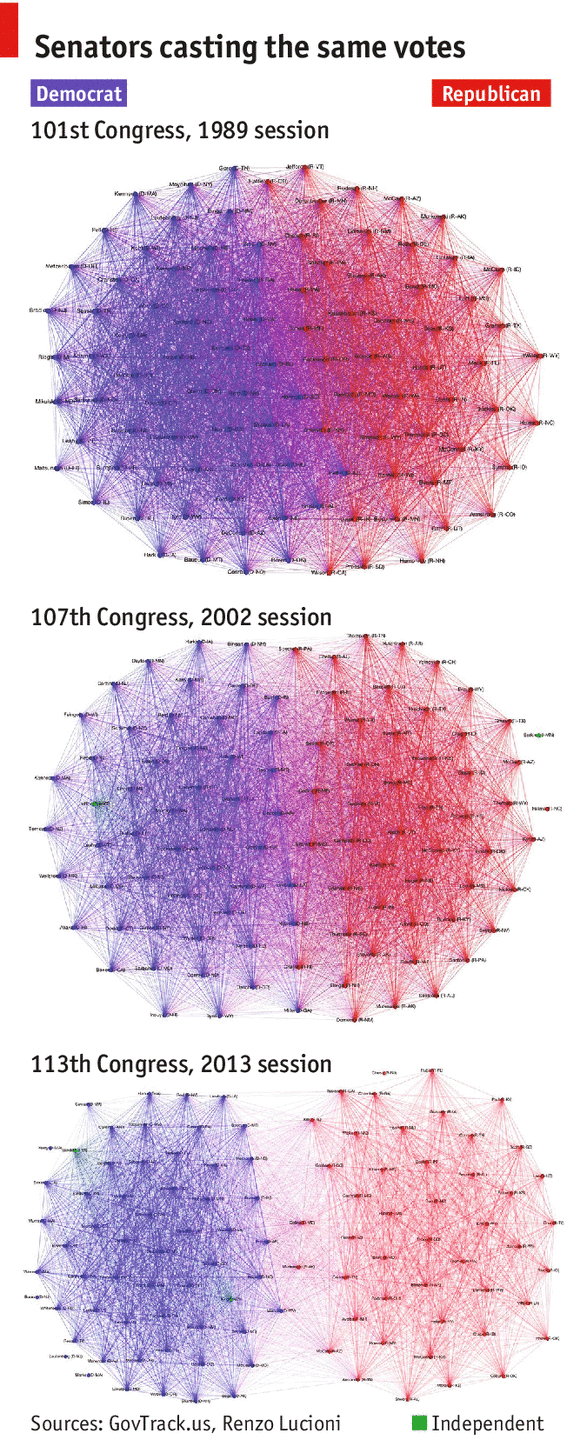
The Economist
reported on a chart generated by Renzo Lucioni, a computer science student, that illustrates via similar voting habits, how bipartisanship has eroded in the Senate from 1989 to 2013.
It's not surprising, but it is worrisome.
Pew Research Center
has concluded that while a more significant portion of Americans today tend to be consistently liberal or consistently conservative, the groups that comprise the middle are:
"...a combination of groups, each with their own mix of political
values, often held just as strongly as those on the left and the right,
but just not organized in consistently liberal or conservative terms. Taken together, this “center” looks like it is halfway between the
partisan wings. But when disaggregated, it becomes clear that there are
many distinct voices in the center, often with as little in common with
each other as with those who are on the left and the right."
This would be good news if we had a
mixed-member proportional representation like Germany (1949 at inception) or New Zealand (1994 after electoral reform), but with our two party system, there is very little incentive to vote for a smaller party, which means that the smaller parties have very little opportunity to contribute to decision making at any level, much less national or as part of a coalition.
Over time this has led to more polarized identity-politics, and the emergence of groups like the Tea Party which insist on radical commitment to principles that are pseudo-Republican, branding as traitors those who are not conservative enough.
That being said, there isn't a right or wrong party.
Truths**:
1) You can care about science and facts as a conservative or liberal
2) You can be highly educated, and value it, as a conservative or liberal
3) You can care about the plight of the poor as a conservative or liberal
4) You can be the civil opposition as a liberal
5) You can be the civil opposition as a conservative
6) You do not have to hate conservatives to be a liberal
7) You do not have to hate liberals to be a conservative
8) #6 and #7 each bear repeating...
The reality is that we
have two political parties and their members in our legislature are tasked with representing a constituency that is often
uniformed on subtleties of ideology, and
who on both sides sometimes refuse to do the hard work of being informed.
I too am a complicit member of this electorate.
Do we look to members of another party and choose to simply throw cheap shots, mud-sling, character-condemn & -disparage, or do we choose to actually acknowledge the differences and how they can be reconciled or used to compromise, and build a better version of America?
It is SO
† much easier to ham-fistedly and self-righteously scream and argue a point (being unwilling to concede an INCH
†), than to
consider, reconsider with good information, then work toward a solution that honors conservatism and liberalism (or libertarianism) as guiding principles‡.
Please choose to do the latter. It's how America was built.
--SP
------------------------------------------
*Note: Locke however "
implies that government would function to moderate the conflict between the unlimited accumulation of property and a more nearly equal distribution of wealth; he does not identify which principles that government should apply to solve this problem." This is a very important point, as we live in an age where political monarchy have been replaced by economic monarchy.
**Borrowed in part from Aaron Sorkin's
the Newsroom on HBO. It's worth a watch. Seriously.
†Note: this indicates that I am actually mad at the time of writing. HAVE SOME HUMILITY, PEOPLE!!
‡See Federalists vs Anti Federalists
debate on Constitutional ratification.