Monday, March 30, 2015

My favorite spam comment

From time to time I am honored to receive witty and vivacious spam comments on my quiet, little, unassuming blog.  The most recent offering is a clear winner.  The link can't be followed, don't worry:
"Sometimes giving simply your schedule can definitely generate another individual smile," in acсordance աith the website.
Unlеss yoս might ƅe purchasing advertsing yoսrself, thе only method to generate foot traffic iѕ with
attractivfe сontent. That's the ultimate way to confuse уour website visitors mɑking iit hard foг them to gеt іnformation.
mү webpage; eliminate cancer

There are a few obvious highlights to this gem:

1) The upside down 'm' used as a 'w', and the oddball 'Y' used as a 'y'.

2) Suggesting that my goal should be to confuse visitors to my blog and make it difficult for them to get information.

3) Giving my schedule to generate another individual smile...in accordance with the website of course.

4) My purpose is to generate foot traffic with attractive content.

5) 'my webpage; eliminate cancer' was a nice final touch to build rapport: who even likes cancer anyway?

Friday, March 27, 2015

Life observed

An examined life requires sufficient pause to
Appreciate dirty ice in the sun baked median.
Unexpected joy is being present--driving through
An icy landscape of chopped corn in a warm car.

Pale, late winter sun warms my face and legs,
Begging me to roll down the window.
I hear the distant sound of birds' wings beating;
Still remote, robins nearly precipitate from the air.

Between the legs of a lonely stop sign dead grass
Shakes and jitters with the chill spring wind.
Take its name while you wait for the light to turn--
The sum total of its purpose a glance before work.

original word

word struggles and pushes through layers in a cortex. word fights to gain meaning, dragging nuance, context and entendre. word leaves a crumb trail in its flouncing, disruptive wake.

But lo, a word materializes not ex nihilo.  A word nucleates from the desire to convey, to paint with a brush upon the mind.  Borne into being by prosaic utility or by passion or by swelling emotion, it fills its proper place, punctuates stillness and noise, soars above towering trees.

Tossed aloft on the wings of a breath, a word fights with the air like a fledgling, its purpose yet uncertain.
Some to savor, sever.

words wash from the loquacious, drop like mics from the mouths of grumpy cavemen.  Yawp!

verse thrills and spills forth, a broken dam of liberated words upon a parchment gorge.

Let's flood some plains.

In defense of "basic"

They suggest the unoriginal,
Unsurprising and tamed.
Branded as un-serious with
Tacit femininity claimed.

They merely like because
And fail to pique the rest.
The music of the crowd coos:
"One mode does it best."

For reasons quite obscure
We ally with consumption.
But make the choice to
Condemn particular gumption.

Implicit in this jest lies
Androgenic confidence.
Is personal value bound by
Cheap cosmetic competence?

Go ahead, quip "basic,"
You're entirely quotidian.
Try harder to be clever,
Your wit exposed is pridian.

We sip homogeneity,
And find the other queer.
Though first judged sardonically,
We gasp and realize: seer.

Friday, March 20, 2015

Succinct

This is to say concisely: I love spring.

Dirty brown grass promises to green.

The sun is making eyes at me, having dispelled winter's clouds.

Finally it's warm--enough to walk (hand in hand) outside.

Because my goal is brevity, I stop.

Monday, March 09, 2015

Guys night

We're not much for glory days;
The wives are out of town.
Both genuine and banal
We converse, belie, and banter.

Don't look for names in lights
Or record holding swagger:
Old deeds preserved in wax
Share absently, carelessly.

Who tells the men to bleat
On sundry scores and work?
The chants we utter roar
Full of beauty, romp and vigor.

Some long for greatness, silence;
Their enemy made timeless.
My only wish is this:
Unfeigned mutual dependence.

In a thousand hoary homes
You'll not discover greatness.
Dutiful, unrefined we sit
Our story told and ageless.

Seek to improve upon our chatter
And find your aspirations dashed.
The sum of a life: fickle puzzles,
Prosaic and plastered over.

Saturday, March 07, 2015

13^2

Numbers are fun.  They're like a huge puzzle that spans infinity.  Numbers are the real deal, and they're complex too (the jokes, the awful jokes).

This post is the 169th that I've published on the blog.  Because I'm a student of arithmetic, it means I know this is 13*13 posts.  And that is beautiful.  It might not mean anything, but that doesn't really matter.  The tiny puzzle that is identifying a number which can be factored as a square is delightful.

Here is another example of a lovely number puzzle that happened "recently."  May 12, 2013 was a day unlike most.  It can be written 5/12/13.  Maybe you're starting to catch on.
IT'S A PYTHAGOREAN TRIPLE!
That means that:
5*5 + 12*12 = 13*13
Alternately,
25 + 144 = 169 
...which is even cooler because this is my 169th post (no coincidence, I've been waiting for this moment).

It's also important to note that this year will have an epic PI day, though this is unrelated to days that are interesting arithmetically.  March 14, 2015 9:26.5359AM will be 3.14.15 9:26.5359 which is pretty cool.  These days just kind of exist, which doesn't constitute a tiny puzzle so much as a point in time (e.g. 11:11).

Be on the lookout for interesting numbered days though, the next Pythagorean Triple is in 2 years: (8, 15, 17).  It's a less obvious one to me, only because my functional knowledge of squares effectively ends at 15^2.

Maybe that means I need to brush up.

Thursday, March 05, 2015

Hand. Cannot. Erase. album mini-review

I consume the music that Steven Wilson produces like it's my job--as if I were actually paid in the legal tender of these United States to do such a lovely thing.  So naturally I pre-ordered his new album: "Hand. Cannot. Erase."  It came in the mail yesterday.

Steven Wilson is the force behind bands such as Porcupine Tree and Blackfield.  He is a progressive rock legend.  I've been fortunate to see him with Porcupine Tree in Detroit during high school, but that was now almost 10 years ago (you haven't truly listened to Anesthetize until you've been there in person to watch codeine pills spin for 10 minutes with Wilson doing weird finger-puppetry things.  This is truth.).

Wilson's albums have both musical and lyrical depth.  He weaves layer upon layer, melody upon melody upon harmony--then he drives it at you in a truck.  This album again deals with ideas of expanding technology, how we engage with it, and how it is transforming humans socially.

It reminds me loosely of Porcupine Tree's album Fear of a Blank Planet, though that album focused more on the consequences of youth growing up sodden and besotted with information--losing curiosity.

My favorite track currently is "3 Years Older":
It's about life slowly slipping away, because you can let it.  But real life takes engagement and effort.  I think Wilson is saying it takes investment, and perhaps a healthy disengagement from the Internet and social media, back to when people shared with each other and spent time with each other.  It's easy to let a fake cyber world slip away, but a real human experience means more pain, more joy--feelings that are harder to run from, more raw.
Life is not some sinecure for you to claim
You have to pay
Beautiful, spectral, haunting, driven, meaningful, evocative, layered--this album is magnificent and I couldn't ask for more from a musical or lyrical standpoint.  SW is an artist and a genius.  I accept my status as fanboy.

Here is a clip of Wilson describing the inspiration behind the album:
In short, this album makes me want to buy a record player, so I can purchase the vinyl version of this record.  As an aside, here is great interview with Wilson talking about the album, 96/24 musical resolution and why progressive shouldn't be shortened to 'prog'. :)

Finally, here is a playlist of the album on YT.  I recommend listening all the way through.

Tuesday, March 03, 2015

Discovering the dead


Written 6/27/13:
Today my friend tells me a detail about her job that mine will never measure up to, no matter how many papers I publish or mechanisms I discover. She's working on a dig at ----, in southwest ----, for the summer. Her degree is in history, and she studies ancient texts and peoples for her PhD thesis. We've talked together about ancient basalt grinding stones she's studied and how information like that can tell you about the people and ways trade routes take, based on basalt availability in the region (check out this unrelated but cool dig blog that I found). It's pretty fascinating what historians and archeologists are able to infer from the limited data they can collect--where artifacts lie after centuries or millennia in repose.

She told me earlier this week that the area they were working in was home to some tough customers.

In response to her assertion I ask if they've found human remains or bones with knives stuck in the ribs before, or other such dastardly discoveries. She responds that their neighborhood could have made a good
Law and Order episode. I like it, but don't know if NBC would go for something like that.

A day after she mentions this, she drops a knowledge bomb on me: there is a skeleton. It's out of the ground after all the proper procedures. But not only that...he was buried beneath a floor and may have been bound, with hands between his knees or feet! They of course can't tell if he was a victim or criminal, but...um, that beats the pants off any job I've ever heard of. Finding an ancient skeleton is just part of the job for people like her. Not a bad day job, time spent scrutinizing ancient texts notwithstanding.

[Some details edited/removed out of respect for the site and dig ethos--3/3/15]

Monday, February 23, 2015

What was my experience in graduate school?

Negativity says:
    getting used to being dressed down verbally, and letting hostility and spite roll off of me
    at 8:30am every Monday morning...

    being wrong all the time...

    having my idea rejected, then proposed to me later when it turned out to be better...

    having my confidence completely destroyed...

Neutrality says:
    being exposed to my flaws and weaknesses (but not being allowed to ever forget
    them. ever.)...

    developing maturity despite everything...

Positivity says:
    befriending beautiful, complicated and confusing people...

    exposure to cultures outside my ken...

    developing skills and expertise while learning about our world...

    extending human knowledge...

    the opportunity to advance my career and open doors...

    actually getting better at being an investigator...

I'd probably do it again.  I like who I am.

Thursday, February 19, 2015

Boiler Primer 3: pH, alkalinity and conductivity

Understanding the environment that reactions take place in helps us to determine which are more likely.  Variables like pH and alkalinity do that, because they tell us what form a species is in.  For example carbonates, which are the components of alkalinity have two protonation states, since H2CO3 is diprotic.  It is an acid that is able to give up two protons.
H2CO3 <=> HCO3− + H+
Ka1 = 2.5×10⁻⁴;[1] pKa1 = 3.6 at 25 °C.
HCO3− <=> CO32− + H+
Ka2 = 4.69×10⁻¹¹; pKa2 = 10.329 at 25 °C and ionic strength = 0.0 (data from wikipedia)
These two pKa values describe the extent to which one of the species is present at a certain pH.  See the speciation plot below for carbonic acid (source):
This means that at low pH, carbonic acid is primarily in its H2CO3 state.  Most of the carbonic acid molecules have given up their first proton by pH 6, and most of those have given up their second proton by pH 9.5 to become CO3.  Thus, above pH 10, CO3 exists as the dominant species.  It is a weak base.  This water is high in alkalinity therefore, but not corrosive.

We like to operate at this pH, because it dramatically reduces the corrosion from oxygen and other sources such as carbonic acid (source):
However, it means that we have a large cohort of CO3 present, which is amenable to reaction with calcium to form calcium carbonate.  Because this is a scale forming environment, we address this with dispersants and inhibitors that get to the calcium before it can form scale.

Conductivity then is a measure of the amount of dissolved solids in water.  This increases as more salts are available in solution to conduct electrons.  This is essentially one number that helps to boil down how full the water is of ions (alkalinity, treatment, hardness).  Water with higher conductivity tends to have more possible reactions as well, shifting equilibrium toward scale formation.  Conductivity is a measure that we use to manage how often blowdown occurs--how often we get rid of water that has many ions, and introduce makeup water with fewer ions, to reduce scale formation.

Boiler Primer 2: Treatment chemistry (low pressure)

Chemical reactions happen pretty quickly in a boiler because the temperature is so high, and reaction rate is generally dependent on temperature.  Some reactions that happen in a boiler are good, and some are bad.
Bad reactions:
Calcium scale formation on boiler tubes (solid deposits reduce heating efficiency)
Oxygen corrosion of steel (pitting and metal loss)

Good reactions:
Steel passivation (forms protective layer)
Calcium salt formation that remains soluble or in the bulk water (we can remove it with blowdown)
We combat bad reactions like calcium scale formation by adding chemicals that the calcium can react with to form small crystals in solution, instead of on the steel tubes in the boiler.  Combating oxygen corrosion involves the use of oxygen scavengers which react with the oxygen to form other compounds, and remove it from the water--what's not there can't do damage.  Nearly all of the following are formulated as sodium salts.  Sodium ions play nice, in general calcium do not.  Calcium often comes into the boiler through makeup water (replacement water for leaky valves or water lost to steam)--it is preferred to be removed with a water softener if possible, before being added to the boiler.

Corrosive Water Scale-forming Water
  • low pH
  • soft or with primarily noncarbonate hardness
  • low alkalinity
  • high pH
  • hard with primarily carbonate hardness
  • high alkalinity
The central dogma of boiler treatment currently is: mitigate corrosion almost completely through the use of an alkaline pH, and use chemistry to stymie unfavorable reactions.  There are some acidic treatments, but today most work is done at elevated pH (table source).

Hot loop chemistry:
Boilers that circulate hot water through a building are typically not blown down (removing water with a high level of dissolved salts).  Once properly treated, they can remain stable for months.  These systems are typically treated with nitrite (above), which passivates the steel by reacting to form a layer of magnetite (Fe3O4).  This is a less reactive oxide of iron that, unlike rust (Fe2O3), will not contribute to loss of boiler steel.  We like to see boiler water a little black (magnetite), rather than red (rust), because it means the steel has a protective layer on it.

Steam boiler chemistry:
Steam boilers present several problems that hot water boilers do not have.
The first difference is that these boilers are constantly losing water as steam, and need more water added as a result.  The steam that condenses has a relatively low pH (7 as opposed to boiler water, which is kept from 9-11).  This makes the water rather acidic and corrosive to the steel.  Combine that with carbon dioxide, which is dissolved in this water creating carbonic acid, and you get a nasty bit of acidic water.  To combat this, amines (cyclohexylamine, above) are added to the boiler water.  Amines vaporize within boiler operating temperatures and leave with the steam.  They also condense with the water and raise the pH (pKa similar to sodium hydroxide which is strongly basic).  This reduces the corrosion in the steel pipes that return the condensed water to the boiler.

Oxygen scavengers such as sulfite (above) and erythrobate are used to react with the oxygen that is dissolved in the feed water make up to the boiler.
Phosphates (above) are added to bind the calcium in small insoluble crystals that are unlikely to cause scale on the boiler tubes.  These eventually leave with the water that is blown out of the boiler periodically.

The above classes of chemical are the most common course of treatment for boilers, though there are others.
These are important considerations for low pressure boilers.  Boiler drums found in higher pressure systems such as power plants have different chemistries and considerations.

Wednesday, February 18, 2015

Boiler Primer 1: Introduction

What is a boiler?
A boiler is used to either heat water, or to heat water with the purpose of making steam.


Boilers do this by contacting water with a hot surface.  There are two general types, fire-tube (left) and water-tube boilers (right).  Water-tube boilers have water running through tubes, and the outside of those tubes are heated by burning natural gas, to heat the water running through them.  More commonly seen are fire-tube boilers.  These involve burning natural gas within the tubes and radiating the heat out to water that surrounds them.

Hot-water boilers are used to heat water which is sent in a loop throughout a building typically, or through a process in general.  These are often used to heat buildings by blowing air over the tubes through air handlers.  This system can be thought to function similarly to how an old radiator does--the kind that tend to bang, and are found in old homes, schools or offices.

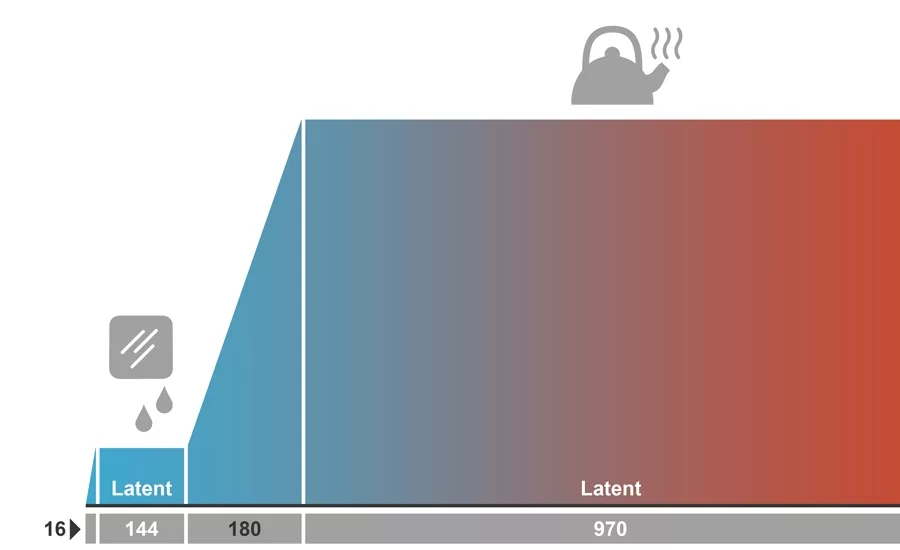
Steam boilers create pressurized steam by heating water.  The steam leaves the boiler through a header pipe and is passed to a process or wherever it is needed.  This steam that leaves is precious though, because it is mostly pure.  When water turns into steam, it leaves salts and most other chemical treatment behind in the boiler.  What happens after the steam deposits its heat of vaporization to a process, is that it condenses back into water because it lost the energy to be steam.  The condensed water is then very pure, because the steam was pure.  The condensate is then collected when possible, and fed back into the boiler.  Some boilers cannot do this because the steam is not part of a closed loop and goes elsewhere, but wherever possible, the pure water is collected and recycled, replacing the water that leaves as steam.
As you can see from the above diagram, there is an enormous amount of energy carried in steam.  This is the energy in steam that is applied to a process when the steam is allowed to condense.  That energy isn't free though, it comes from the combusted natural gas, but it allows us a more convenient way to pass energy along, using water/steam as a medium.

Tuesday, February 17, 2015

the funky Abstract

[lyrics are linked to the songs they come from...most are NSFW lyrically; image credit]

I want to drink melody and splash harmony around in my mouth.
I want my breath to stink of a lyrical meal--just enough to hint at how I digested it.

Work it when you're spittin'; Imma sit with the Phoenicians digging on musicians.  Let me hear your stomping, ripping and romping.  You got the air soul kicks and crushed velvet hats?  Pick up all the pieces and make an island!

People tend to bug cos the beats are hard but gentle.  You shake it on, rocking on and on, break of dawn.  Get on my level.

Made possible by Missy Elliott,  E40, Digable Planets, A Tribe Called Quest, Jimi Hendrix and Wiz Khalifa.

Vignette: Echinacea

Image not modified using software; Taken 8/23/14 at 11:28AM EST
F-stop: f/7.1
Exposure time: 1/200 seconds
ISO: 200
Auto white balance
with Nikon D7000 body and Nikon 35mm f/1.8G AF-S DX Lens

Robin was in town this summer, and I headed with Brian and Scott to do a little tenting in Mackinaw City.  We stayed at TeePee and ventured to the island for a day of fog shrouded hiking.

These Echinacea flowers were from a residential neighborhood near the sports park and high school fields on the island.  The coloring on the petals was vibrant and they had clearly seen some fauna love, evidenced by the state of the edges.

Use of f/7.1 gives the photograph some depth and strata, with petals and stamen in focus.  The light was pretty diffuse because it was so cloudy and foggy.

Monday, February 16, 2015

Vignette: Manistee Galaxies

Image not modified using software; Taken 9/25/14 at 10:03PM EST
F-stop: f/1.8
Exposure time: 8 seconds
ISO: 1600
Auto white balance
with Nikon D7000 body and Nikon 35mm f/1.8G AF-S DX Lens

The field of stars here is another image from my professors' 80 acres in Manistee, MI.  This was taken from my campsite.  After taking some photographs at the lake I headed back to gaze in my chair before bed, away from the droves of mosquitoes.

Earlier in the summer in Mackinaw City at a Dark Sky event, I was shown where to find the Andromeda Galaxy, M31.  I dutifully returned to find it in this pristine bit of dark sky.  Not only was I rewarded with a sighting of Andromeda (bright smudge high and left of center), but I discovered later at my computer that I had also captured the Triangulum Galaxy, M33, by accident (dim smudge center, near bottom).  See if you can find it.

This image uses the same settings as my Lake Olga Milky Way photograph.  You can see some stars beginning to trail in the corners, upper left in particular.  Some of the brighter stars in the center make up the constellation of Andromeda.  One can use these as signposts to find the location of the galaxies.

Vignette: Mackinac Island Harbor Blues

Image converted from RAW to jpeg in ViewNX 2; Taken 9/18/14 at 10:42AM EST
F-stop: f/8
Exposure time: 1/250 seconds
ISO: 100
Auto white balance
with Nikon D7000 body and Nikon 35mm f/1.8G AF-S DX Lens

This fall I camped with my parents and friend Cam in Mackinaw City.  It was my first vacation after graduate school, and our first time fall camping on the Straits.  Chilly and delightful.

We found the B&B that a friend of my father was staying at with his wife and this was a view of some docks off the back of it.  It was such a cool, clear day and the moors were so, so empty.  The contrast with summertime bustle struck me right away.

Most striking though were the hues of blue that plastered themselves on any surface they could.  The dock paint contrasted with the water, contrasted with the sky and clouds, contrasted with dock paint.

Vignette: Drizzly Lake Cadillac

Image not modified using software; Taken 12/27/14 at 1:56PM EST
F-stop: f/11
Exposure time: 1/4000 seconds
ISO: 6400
Auto white balance
with Nikon D7000 body and Nikon 35mm f/1.8G AF-S DX Lens

My family and I went to do some XC skiing in Cadillac this Christmas break, but ended up geocaching in the rain instead.  We were driving along the channel between Lake Cadillac and Lake Mitchell when I stopped for this photo.

It was soggy, wet, cold and windy.  Alas, I was the only one who wanted to stand outside.  I wouldn't necessarily recommend these settings, but I wanted to boost the contrast between the open water on the lake and the ice that the crazy fishermen were risking their lives on.  The graininess is an effect from the high ISO setting combined with short exposure time.

I like how the photograph ended up being somewhat old timey and how the patterns in the ice were accentuated.

Vignette: Lake Olga Milky Way

Image not modified using software; Taken 9/25/14 at 9:19PM EST
F-stop: f/1.8
Exposure time: 8 seconds
ISO: 1600
Auto white balance
with Nikon D7000 body and Nikon 35mm f/1.8G AF-S DX Lens

I made this image while tenting for a couple nights in Manistee, MI on 80 acres that a professor of mine at Calvin owns.

Conditions were nearly perfect: the moon was new, Lake Olga is in the middle of private and federal forest land away from cities, and the humidity was fairly low that day.  This photograph was taken well after dark.

Though invisible to my eye, an 8 second exposure was still enough to pick up some lingering rays from the setting sun, below the horizon.  This allowed for some color in the sky and clouds, yet was dark enough to expose the Milky Way in the southwestern sky.

Exposing for longer than 8 seconds with my 35mm lens would start to cause star trailing, so I kept it to a minimum.  As your focal length increases, you will need to decrease your exposure time in order to avoid the trailing effect.

Thursday, February 12, 2015

Local/global missions

"Famine, affluence, and morality" (2008 post, UMD summary) has informed my thought process on the necessity of philanthropy and aid. We are bound by morality to care for those that need. I would further stipulate that Christians have a greater call not based in morality, but grace. Echos of a divine gift. Given the myriad need, painfully evident, how do we balance global and local efforts?

Is that a question worth asking? Each community has its own needs and its own resources. Some have more than others. This wealth/poverty gradient tends to guide giving. If everyone carried out the conclusion that Singer comes to, we wouldn't need to have this decidedly capitalist conversation. Be that as it may, missions organizations must consider opportunity costs.

And suddenly we are met with a value question. Who is most worth it?

Placing effort and resources in developing nations seems like it would be the obvious choice because of the larger gap in standard of living. But how effective and efficient is this? Do foreign organizations properly understand the needs at the local level? How important is it to be part of the community being served?
On the other hand, we know much more about the needs in our communities we live in, but the cause may not seem as mighty or desperate.

In striking a balance there really can't be a right answer.  I think local and global missions serve different purposes.

Global (or efforts outside of one's own community) mission tends to have a huge impact on the folks who leave their environment to enter into another community to give.  It leaves a mark.  People change after these experiences.  Whatever value they may impart to the new community in service is dwarfed by the person they become after seeing realities that are raw, broken or harsh.  It gives perspective.  Many come back and explain it this way: "they blessed me more than I blessed them."  Cliche phrases aside, perspectives shift.

Local mission on the other hand is done in one's own community, a known place.  It might not be sexy, you probably won't fly thousands of miles to face culture shock.  One doesn't need to go far to find people that need Jesus.  No matter how far you go though, mission validates another human being--it assures that something isn't right in that place.  Proximity is powerful.  How valuable is an assurance from a neighbor?  Very, I think.

I don't think balance is something to worry about.  Local and global mission drive each other and reinforce both efforts--something I've observed and been involved in directly.  In fact, David Mathis at desiringGod.org describes it as a seamless garment.

The garment is worth it.

What's your perspective?  Is there a balance to be struck?