Thursday, February 19, 2015

Boiler Primer 2: Treatment chemistry (low pressure)

Chemical reactions happen pretty quickly in a boiler because the temperature is so high, and reaction rate is generally dependent on temperature.  Some reactions that happen in a boiler are good, and some are bad.
Bad reactions:
Calcium scale formation on boiler tubes (solid deposits reduce heating efficiency)
Oxygen corrosion of steel (pitting and metal loss)

Good reactions:
Steel passivation (forms protective layer)
Calcium salt formation that remains soluble or in the bulk water (we can remove it with blowdown)
We combat bad reactions like calcium scale formation by adding chemicals that the calcium can react with to form small crystals in solution, instead of on the steel tubes in the boiler.  Combating oxygen corrosion involves the use of oxygen scavengers which react with the oxygen to form other compounds, and remove it from the water--what's not there can't do damage.  Nearly all of the following are formulated as sodium salts.  Sodium ions play nice, in general calcium do not.  Calcium often comes into the boiler through makeup water (replacement water for leaky valves or water lost to steam)--it is preferred to be removed with a water softener if possible, before being added to the boiler.

Corrosive Water Scale-forming Water
  • low pH
  • soft or with primarily noncarbonate hardness
  • low alkalinity
  • high pH
  • hard with primarily carbonate hardness
  • high alkalinity
The central dogma of boiler treatment currently is: mitigate corrosion almost completely through the use of an alkaline pH, and use chemistry to stymie unfavorable reactions.  There are some acidic treatments, but today most work is done at elevated pH (table source).

Hot loop chemistry:
Boilers that circulate hot water through a building are typically not blown down (removing water with a high level of dissolved salts).  Once properly treated, they can remain stable for months.  These systems are typically treated with nitrite (above), which passivates the steel by reacting to form a layer of magnetite (Fe3O4).  This is a less reactive oxide of iron that, unlike rust (Fe2O3), will not contribute to loss of boiler steel.  We like to see boiler water a little black (magnetite), rather than red (rust), because it means the steel has a protective layer on it.

Steam boiler chemistry:
Steam boilers present several problems that hot water boilers do not have.
The first difference is that these boilers are constantly losing water as steam, and need more water added as a result.  The steam that condenses has a relatively low pH (7 as opposed to boiler water, which is kept from 9-11).  This makes the water rather acidic and corrosive to the steel.  Combine that with carbon dioxide, which is dissolved in this water creating carbonic acid, and you get a nasty bit of acidic water.  To combat this, amines (cyclohexylamine, above) are added to the boiler water.  Amines vaporize within boiler operating temperatures and leave with the steam.  They also condense with the water and raise the pH (pKa similar to sodium hydroxide which is strongly basic).  This reduces the corrosion in the steel pipes that return the condensed water to the boiler.

Oxygen scavengers such as sulfite (above) and erythrobate are used to react with the oxygen that is dissolved in the feed water make up to the boiler.
Phosphates (above) are added to bind the calcium in small insoluble crystals that are unlikely to cause scale on the boiler tubes.  These eventually leave with the water that is blown out of the boiler periodically.

The above classes of chemical are the most common course of treatment for boilers, though there are others.
These are important considerations for low pressure boilers.  Boiler drums found in higher pressure systems such as power plants have different chemistries and considerations.

Wednesday, February 18, 2015

Boiler Primer 1: Introduction

What is a boiler?
A boiler is used to either heat water, or to heat water with the purpose of making steam.


Boilers do this by contacting water with a hot surface.  There are two general types, fire-tube (left) and water-tube boilers (right).  Water-tube boilers have water running through tubes, and the outside of those tubes are heated by burning natural gas, to heat the water running through them.  More commonly seen are fire-tube boilers.  These involve burning natural gas within the tubes and radiating the heat out to water that surrounds them.

Hot-water boilers are used to heat water which is sent in a loop throughout a building typically, or through a process in general.  These are often used to heat buildings by blowing air over the tubes through air handlers.  This system can be thought to function similarly to how an old radiator does--the kind that tend to bang, and are found in old homes, schools or offices.

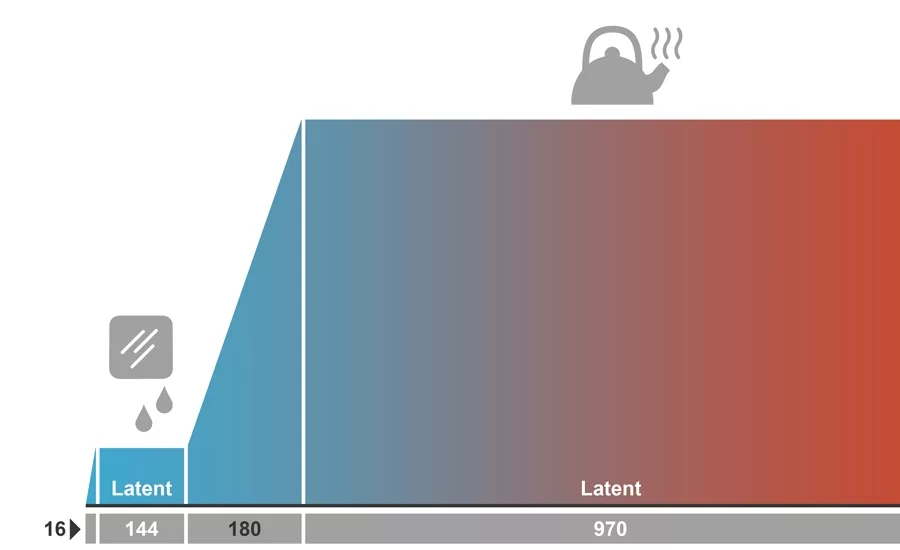
Steam boilers create pressurized steam by heating water.  The steam leaves the boiler through a header pipe and is passed to a process or wherever it is needed.  This steam that leaves is precious though, because it is mostly pure.  When water turns into steam, it leaves salts and most other chemical treatment behind in the boiler.  What happens after the steam deposits its heat of vaporization to a process, is that it condenses back into water because it lost the energy to be steam.  The condensed water is then very pure, because the steam was pure.  The condensate is then collected when possible, and fed back into the boiler.  Some boilers cannot do this because the steam is not part of a closed loop and goes elsewhere, but wherever possible, the pure water is collected and recycled, replacing the water that leaves as steam.
As you can see from the above diagram, there is an enormous amount of energy carried in steam.  This is the energy in steam that is applied to a process when the steam is allowed to condense.  That energy isn't free though, it comes from the combusted natural gas, but it allows us a more convenient way to pass energy along, using water/steam as a medium.

Tuesday, February 17, 2015

the funky Abstract

[lyrics are linked to the songs they come from...most are NSFW lyrically; image credit]

I want to drink melody and splash harmony around in my mouth.
I want my breath to stink of a lyrical meal--just enough to hint at how I digested it.

Work it when you're spittin'; Imma sit with the Phoenicians digging on musicians.  Let me hear your stomping, ripping and romping.  You got the air soul kicks and crushed velvet hats?  Pick up all the pieces and make an island!

People tend to bug cos the beats are hard but gentle.  You shake it on, rocking on and on, break of dawn.  Get on my level.

Made possible by Missy Elliott,  E40, Digable Planets, A Tribe Called Quest, Jimi Hendrix and Wiz Khalifa.

Vignette: Echinacea

Image not modified using software; Taken 8/23/14 at 11:28AM EST
F-stop: f/7.1
Exposure time: 1/200 seconds
ISO: 200
Auto white balance
with Nikon D7000 body and Nikon 35mm f/1.8G AF-S DX Lens

Robin was in town this summer, and I headed with Brian and Scott to do a little tenting in Mackinaw City.  We stayed at TeePee and ventured to the island for a day of fog shrouded hiking.

These Echinacea flowers were from a residential neighborhood near the sports park and high school fields on the island.  The coloring on the petals was vibrant and they had clearly seen some fauna love, evidenced by the state of the edges.

Use of f/7.1 gives the photograph some depth and strata, with petals and stamen in focus.  The light was pretty diffuse because it was so cloudy and foggy.

Monday, February 16, 2015

Vignette: Manistee Galaxies

Image not modified using software; Taken 9/25/14 at 10:03PM EST
F-stop: f/1.8
Exposure time: 8 seconds
ISO: 1600
Auto white balance
with Nikon D7000 body and Nikon 35mm f/1.8G AF-S DX Lens

The field of stars here is another image from my professors' 80 acres in Manistee, MI.  This was taken from my campsite.  After taking some photographs at the lake I headed back to gaze in my chair before bed, away from the droves of mosquitoes.

Earlier in the summer in Mackinaw City at a Dark Sky event, I was shown where to find the Andromeda Galaxy, M31.  I dutifully returned to find it in this pristine bit of dark sky.  Not only was I rewarded with a sighting of Andromeda (bright smudge high and left of center), but I discovered later at my computer that I had also captured the Triangulum Galaxy, M33, by accident (dim smudge center, near bottom).  See if you can find it.

This image uses the same settings as my Lake Olga Milky Way photograph.  You can see some stars beginning to trail in the corners, upper left in particular.  Some of the brighter stars in the center make up the constellation of Andromeda.  One can use these as signposts to find the location of the galaxies.

Vignette: Mackinac Island Harbor Blues

Image converted from RAW to jpeg in ViewNX 2; Taken 9/18/14 at 10:42AM EST
F-stop: f/8
Exposure time: 1/250 seconds
ISO: 100
Auto white balance
with Nikon D7000 body and Nikon 35mm f/1.8G AF-S DX Lens

This fall I camped with my parents and friend Cam in Mackinaw City.  It was my first vacation after graduate school, and our first time fall camping on the Straits.  Chilly and delightful.

We found the B&B that a friend of my father was staying at with his wife and this was a view of some docks off the back of it.  It was such a cool, clear day and the moors were so, so empty.  The contrast with summertime bustle struck me right away.

Most striking though were the hues of blue that plastered themselves on any surface they could.  The dock paint contrasted with the water, contrasted with the sky and clouds, contrasted with dock paint.

Vignette: Drizzly Lake Cadillac

Image not modified using software; Taken 12/27/14 at 1:56PM EST
F-stop: f/11
Exposure time: 1/4000 seconds
ISO: 6400
Auto white balance
with Nikon D7000 body and Nikon 35mm f/1.8G AF-S DX Lens

My family and I went to do some XC skiing in Cadillac this Christmas break, but ended up geocaching in the rain instead.  We were driving along the channel between Lake Cadillac and Lake Mitchell when I stopped for this photo.

It was soggy, wet, cold and windy.  Alas, I was the only one who wanted to stand outside.  I wouldn't necessarily recommend these settings, but I wanted to boost the contrast between the open water on the lake and the ice that the crazy fishermen were risking their lives on.  The graininess is an effect from the high ISO setting combined with short exposure time.

I like how the photograph ended up being somewhat old timey and how the patterns in the ice were accentuated.

Vignette: Lake Olga Milky Way

Image not modified using software; Taken 9/25/14 at 9:19PM EST
F-stop: f/1.8
Exposure time: 8 seconds
ISO: 1600
Auto white balance
with Nikon D7000 body and Nikon 35mm f/1.8G AF-S DX Lens

I made this image while tenting for a couple nights in Manistee, MI on 80 acres that a professor of mine at Calvin owns.

Conditions were nearly perfect: the moon was new, Lake Olga is in the middle of private and federal forest land away from cities, and the humidity was fairly low that day.  This photograph was taken well after dark.

Though invisible to my eye, an 8 second exposure was still enough to pick up some lingering rays from the setting sun, below the horizon.  This allowed for some color in the sky and clouds, yet was dark enough to expose the Milky Way in the southwestern sky.

Exposing for longer than 8 seconds with my 35mm lens would start to cause star trailing, so I kept it to a minimum.  As your focal length increases, you will need to decrease your exposure time in order to avoid the trailing effect.

Thursday, February 12, 2015

Local/global missions

"Famine, affluence, and morality" (2008 post, UMD summary) has informed my thought process on the necessity of philanthropy and aid. We are bound by morality to care for those that need. I would further stipulate that Christians have a greater call not based in morality, but grace. Echos of a divine gift. Given the myriad need, painfully evident, how do we balance global and local efforts?

Is that a question worth asking? Each community has its own needs and its own resources. Some have more than others. This wealth/poverty gradient tends to guide giving. If everyone carried out the conclusion that Singer comes to, we wouldn't need to have this decidedly capitalist conversation. Be that as it may, missions organizations must consider opportunity costs.

And suddenly we are met with a value question. Who is most worth it?

Placing effort and resources in developing nations seems like it would be the obvious choice because of the larger gap in standard of living. But how effective and efficient is this? Do foreign organizations properly understand the needs at the local level? How important is it to be part of the community being served?
On the other hand, we know much more about the needs in our communities we live in, but the cause may not seem as mighty or desperate.

In striking a balance there really can't be a right answer.  I think local and global missions serve different purposes.

Global (or efforts outside of one's own community) mission tends to have a huge impact on the folks who leave their environment to enter into another community to give.  It leaves a mark.  People change after these experiences.  Whatever value they may impart to the new community in service is dwarfed by the person they become after seeing realities that are raw, broken or harsh.  It gives perspective.  Many come back and explain it this way: "they blessed me more than I blessed them."  Cliche phrases aside, perspectives shift.

Local mission on the other hand is done in one's own community, a known place.  It might not be sexy, you probably won't fly thousands of miles to face culture shock.  One doesn't need to go far to find people that need Jesus.  No matter how far you go though, mission validates another human being--it assures that something isn't right in that place.  Proximity is powerful.  How valuable is an assurance from a neighbor?  Very, I think.

I don't think balance is something to worry about.  Local and global mission drive each other and reinforce both efforts--something I've observed and been involved in directly.  In fact, David Mathis at desiringGod.org describes it as a seamless garment.

The garment is worth it.

What's your perspective?  Is there a balance to be struck?

Tuesday, February 10, 2015

Lyrics and singing in worship

Singing loudly and sincerely in worship is one of my favorite things.  I developed the love during LOFT on Sunday nights as a student at Calvin and never looked back.  Singing is a very emotional experience--the voices of those all around you fill the space with melody and harmony.  The sound washes over you.  In fact, it's easy to get caught up while singing in worship.  And it can be both good and bad.

To be caught up in worship of the Creator is a beautiful thing.  To be caught up in singing the words to a catchy, well written song is an entirely different thing.  It is the latter that I struggle with.

It's important to think about the lyrics--even to go as far as to periodically stop singing, to listen and evaluate.  Do I mean every word that is displayed on the screen?  Is this my honest prayer?

Most of the time I mean the things I say.  So I find myself stopping, listening.  I consider the words coming out of my mouth--do they track?  Sometimes yes, sometimes no.  If I sang every word I ever saw on the screen during every service I attended, I would be a liar.  And I have been a liar...a well meaning liar.  Perhaps you have too.

But...it's hard to feel an emotional connection while thinking about intention and meaning.  Emotion is part of worship because we are emotional beings.  There is value to it.  Striking the balance between intention and emotion in worship may be difficult, but I think it is important if we hope to bring glory to and find delight in God through our worship.

Monday, February 09, 2015

8 ways lists enrich our lives

This is a poorly conceived "meta analysis" of "list 'culture'" on the "internet" "cir"ca 2014/2015.  Navigate the following list-about-how-awesome-lists-are at your own peril.
  1. Lists give us a reason to use ordinal numbers in a way that disrespects rank because it's rendered meaningless.
  2. The fine folks at buzzfeed keep their jobs, and unemployment numbers stay down.
  3. We validate ourselves and determine what kind of people we are based on another person's conception of group characteristics, despite a total lack of expertise in the list maker.
  4. Lists allow us to make "No true Scotsman" judgments of others.
  5. We can learn exciting new things about ourselves, such as which Disney Princess best represents the condition of our liver/kidneys/spleen.
  6. Lists free us from reading long prose by breaking text up into bitesized portions, contributing to our soundbyte-ridden-culture-of-noise that promotes smaller attention spans.
  7. We are able to avoid human contact in public places and transit by staying glued to our scintillating phones, pretending to be in conversation or communication, though conveniently engaging ourselves in short bursts via list format.
  8. Because I love them.
In conclusion, lists are bae and I need them to navigate the confusing place that the 21 century is becoming, and the way the world has been since 1989.

Friday, February 06, 2015

Blind faith

An upsetting observation I've made in Christianity today has to do with the concept of blind faith.  Specifically, I take issue with the value placed in blind faith--the idea that true faith must be blind.  This is touted both by fundamentalist Christians and by members of the new-atheism movement.

The opposite seems more likely.  Faith that results from curiosity and questions and dissatisfaction has been tested and proven.  It has dimension and reason and conflict.  Faith borne of struggle has been places and is dynamic.  Faith with a history is compelling--it has a narrative and a song that it sings.  In many cases, it has almost died.

Is trust more profound if it proceeds from a refusal to engage or approach?  That's never the case.

Does it mean that we don't believe God, or that we're suspicious?  It can.  But maybe it means that we honestly just don't understand all that God is, and that through questions and doubt, we can wrap a little bit of our brains around her/his attributes.

I don't want the church to be satisfied with letting others do our thinking for us.  The pastors I know welcome questions.  They love conversations about tough doctrine.  Pastors are probably ok if you don't take their word for it.  Because they study the Bible, they probably want you to as well.

The FaithFacts article is superb, and I like what they have to say:
God has not told us everything there is to know, but He has told us enough with which to navigate existence.
I'll leave off with an interesting metaphor from Stand to Reason:
The good news about faith is that God honors even the smallest amount. When I fly around the country, I see both seasoned travelers and first-time fliers. The businessmen are relaxed, almost bored, at the thought of flying 500 mph at nearly 40,000 feet above the earth. The grandma on her first flight, however, grips her armrest like her life depends on it. Although the seasoned traveler has more trust (faith) in the airplane, both passengers safely arrive at the destination and at the same time. Their outcome is the same, regardless of how large or little their faith in flying.

Got Questions?         |         Summit         |         FaithFacts         |         Stand to Reason

Wednesday, February 04, 2015

Faith, confidence and criticism

What does it mean to be confident in your faith?  Confidence in faith sounds like an oxymoron.

Faith is a trust.  It means you are at an information disadvantage and someone has claimed an idea that you cannot personally verify.  And you give them your credence.

I have faith in God.  God is an untestable hypothesis.

What gives me confidence in a concept such as God then?  See Hebrews 11.

1. Now faith is being sure of what we hope for, being convinced of what we do not see.
2. For by it the people of old received God’s commendation.
3. By faith we understand that the worlds were set in order at God’s command, so that the visible has its origin in the invisible.

I don't like the idea of being convinced of something that I have no evidence for.  But, I still follow Jesus.  What it comes down to, is that I accept the Bible and the God that is written about in it.

The Bible is a weird book, and I kind of like that about it--full of disaster, calamity, betrayal and love, it doesn't hide much.  My trust is that the God presented in the Bible is real, invisible yes, and honest in his interactions with humanity.

I trust that the story in it about God and her/his followers is true.  I believe that God called a group of Israelites to follow him and that he calls us too.  I like reading about the way the people of old explained who and what God is, and I think that we still try to do that, with our own paltry metaphors.

Faith shouldn't stop us from struggling though.  There is space to be critical of the Bible and of God.  In fact Jacob wrestled with God and then received the name Israel, becoming in essence the first ruler as the father of the twelve tribes.  Kind of an odd turn of events after a struggle with God.


Struggling and questioning only makes having faith harder--depending on your questions, nigh on impossible.  But to me that gives it added dimension and so much more meaning.  So, have confidence, have faith, have questions and have doubts.  You're still welcome at the table.

Friday, January 30, 2015

"Diversity" and the multinorm

My friend Jade writes expressively and poignantly about, well everything.  She posted about diversity in campus ministry and got me thinking.

Jade cuts right to the point with this statement:
Seeking to increase structural diversity (i.e. the people who are participants in the campus ministry) without seeking to increase multicultural competence to honor them once they GET there will always betray a lack of forethought & process.
One of the things that inhibits the development of true diversity and meaningful connections is the retention of a singular "normal" culture.  This is a regard for different cultures that does not recognize the existence of multiple normals.  To me this is particularly apparent in the part of west Michigan where the white, middle class Dutch culture tends to be acknowledged as normal.  I imagine this to be true of most homogenous communities.  Other is often regarded as a curiosity and as a shift from the expected normal.  It takes more than curiosity to promote diversity.

The view of another culture as a curiosity does not allow it to be engaged meaningfully, especially if it is relegated to an object of entertainment.  Culture can become an object to be used and discarded at will or impulse, a fun theme.

Unfortunately it can be exhausting to put time into properly understanding and appreciating different cultures.  Culture is how we self-identify, so it takes empathy to do diverse communities properly.  Organizations need to be able to value and support multiple identities.  It starts with people.  It takes the willingness to walk miles and miles and miles in the shoes of other people.  Different people.  People that you might find difficult to identify with.  Cultural fluency is like language fluency in that it takes time and in most cases, immersion.

In my experience, true, beautiful diversity was not coaxed, grown and cultivated by a group of White people, or by a group of Black people or any other homogenous group.  It was supported by, and happened because of heterogeneous community.  See the community toolbox for tips!  Start by accepting anyone that wants to join your group.

Unless we can commit to the development of multiple normals, then we cannot really talk about diversity.  There would be no point.

Tuesday, January 27, 2015

Depth of feeling

To feel intensely is to take delight in a frigid drive through a barren, white fieldscape of chopped corn, just because at that moment you can be in that place and not in another.

To feel deeply is to agonize over a person or thought for hours, like they were there with you.

To feel intensely is to constantly desire to project your experiences in life onto the ones you love and care about--to crave reciprocity and validation.

+ to be talked up and talked down by friends over trivialities, and always hope that they don't get sick of you.
+ to share too much with too many people too quickly because feedback is a drug.
+ to feel elated and devastated over the slightest of interactions and to over-analyze every last feeling that passes the cortex.
+ to withdraw and hope that no one notices until you're ready to re-emerge.
+ to drink music from a ladle and spill it all over.
+ to be effusive, sometimes uncomfortably.
+ to hide this intensity.

through introspection to somehow come back to a balance and do it all over again the next time.  When the worst is always the first thought, it can take until the afternoon to recover.

Monday, January 26, 2015

Being missional in Georgetown township

Being missional is hard.  It took me 24 years to have a missional mindset that worked for me.  Before that, it was a lofty ideal, a thing that good Christians did.  It was a concept I didn't really try to understand because I wasn't that kind of Christian.

Then I arrived at Penn State.  My Christian bubble had burst.  The surface was pricked and the tension broke, collapsing upon itself.  I was terrified and mortified that someone would notice I was a Christian.  They would lambast me and humiliate me in front of my peers.  I would feel stupid, exposed and lose everything.

It didn't take long to make friends among my cohort.  We three, Athos and Aramis and Porthos, from Calvin found friendship among our peers.  For myself, I made some of my first non-Christian friends.  Some were atheist, others agnostic (a self described atheist-agnostic even), some Muslims, others Hindu and many were just apathetic.  It was classes like Transport (Deen), Statistical Thermodynamics, and Reaction Kinetics that really brought us together.  It was confusion and unending problem sets and projects, that kept us together as we pored over our derivations and code.  It was Anupam's understanding of calculus that was so so so superior to mine XD.

And just like that, I had friends who didn't think like me.  In some cases we were diametrically opposed.  And we had lunch together nearly every day.  We drank too much, ate too much (purse bacon) and partied together.  And we had long conversations about politics and about science and about how "I'm right and your tensor has the wrong rank!"  But eventually, about "how can we solve this?"

It was in our second year that we a few of us started having deeper back and forths about meaning and religion and belief and unbelief.  It was coffee and lunch and interviews and dialogue.  It was friendship.  It wasn't Hudsonville and it wasn't Georgetown township.  But it can be.

You like going to that brewpub down the street?  Make a friend there.  No strings attached, a friend.  Do you have neighbors that aren't Christians?  Befriend them and have dinner parties.  Don't steer the dialogue, have conversations.  Did your firm hire a new guy/gal?  Get coffees or beers after work.  Talk about hobbies and dreams.  Those guys and girls on your floor in college that don't go to church?  Spend time with them, watch movies, stay out late doing nothing together.  Cause mischief.

Go where the people who don't know Jesus are.  They aren't going to walk into your church.

But when should I ask them to come to church?  Try this first: work at a friendship.  God doesn't need you.  But that doesn't mean God doesn't want to use you.  God works through Christians that are open to seeing life through in the long term.  That doesn't mean shelving the gospel or hiding your faith.  It means real friendship without conditions and taking the opportunities that God gives you.  Unless we make space and trust for these conversations to happen, they won't.  So make friends and let God work.

Saturday, January 24, 2015

bee and bird

Once there was a little bee, rather bookish, and only dimly aware of the ways of the world.  The bee was content to buzz around and think of nectar and stamen and all the supple petals in a variegated field of tulips.  He often went to and fro among meadows and fields, partaking of the pollen in myriad blooms.  Each new flower seemed a new oasis to drink and taste and ponder.

One day, perusing a lilac blossom, the bee noticed perched nearby a feathered, curious creature.  A bird.  It was rather unlike the bee, though both made their way though the air with ease.  Our little bee was unsure of what the nearby avian wanted with the lilacs.  It had no way of collecting the delicious pollen, and seemed to be different from the bee in almost every way.  The bee tried to greet the bird by shaking his tail and buzzing a bit, but the bird didn't appear to notice and flew away.

Out in the world of flower, nectar, tree and brush the bee began to notice birds as they flitted from tree to tree and made loud squawks and cheerful chirrups.  They were hard to understand.  Birds didn't wiggle and buzz to one another.  They were beautiful, imposing and scary, baleful.  The bee liked them.  He began to pick up on some of their sounds, noticed the differences in tone and frequency.  Though the bee could not make those sounds, he still tried to greet nearby bees when they lit upon nearby branches.  They did not seem to care.

It was many a day before the bee succeeded in his efforts.  One day he was buzzing with some other bees, doing his little butt wiggle, when a small, songbird perched nearby and took interest.  Her head was black, wings brown, with dull copper breast feathers.  The bird made some of the same wiggles and chirruped.  The bee looked up at the creature that had been an object of fear and worry and mystery.  He waved his butt back at her and made a little warble, like the bird had.  Cocking her head, the robin ruffled her feathers a bit and flew away.

The bird often returned to perch near the bee.  They would trade buzzes, chirps and warbles.  Over time, the two developed a kind of understanding, common movement and sound.  Bee would tell bird of hive life, of dances and work and nectar.  Bird would describe nests and soaring and heights and worms.  Bird did not seem as scary as other birds.  Maybe birds were more like bee than he knew.  They were pulchritudinous and deft and fell and enigmatic.  Sometimes he liked to wiggle in a circle to the birds.
--
I was inspired to write this after reading "Davita's Harp" by Chaim Potok, from the stories of the character Jakob Daw.  My little sister gives good gifts.

Wednesday, January 21, 2015

Finding God space again


My physical body and motley pile of trappings and belongings have been spirited away from State College for 5 months already.  That went pretty painlessly, though I definitely left it all in the middle of the floor in my parents basement until I had to clear it away for Christmas.  My routine has even made the trip, now that I have work and a schedule that I'm responsible for.  Things look like they're coalescing back to normal on the outside.  On the work side.  On the material side.

If only moving were as simple as transporting collections of atoms.

I'm still moving back emotionally and spiritually.  Those are the parts that give me the most inner turmoil and heartache.  For good reason.

Emotionally
During one of the most intellectually stimulating, stressful, and at times, traumatic periods of my life, I was part of a group of people that were experiencing similar delights, joys and atrocities.  Those bonds don't dissolve (nor would I want them to!), or fade from memory quickly.  The feeling of disjointed connectedness remains, with a physical separation of hundreds of miles.  I feel pangs and memories and aches almost daily.

Friendships change over time and space.  In a way they become windows and views of former places from lofty heights.  The lofty heights of memory, text messages and phone calls don't do friendship justice.  Sharing a cup of coffee or a beer over the phone is...well...inane.  But that is how life forces us to reconcile new places; memories and intermittent contact.  And we drink deeply of the cold, sweet water of reconnection.

Emotionally, I may always straddle the places in life where I've felt and experienced intense emotion.  Everyone does and deals with it in their own ways.  Some ignore the past, some live in the past, and others come to terms with a life of small, constant, distant tugs.  I imagine the latter will always be true for me.  There is too much in the past to forget it, and too much in the future to embrace with open arms.

Spiritually
Perhaps the language of moving and fixed destinations is not appropriate for the topic of a spiritual journey.  However, the setting in any journey does change, and impact the traveler directly, so in that sense I am moving in a different phase of life spiritually.

Life in Penn State Christian Grads (PSCG) was a very stimulating experience.  My head-space was occupied with lofty precipices and even more subterranean lows when it came to questions of faith, meaning and purpose.  There were honest conversations between minds questioning and probing, that received no answers some days and few the next.  Daily struggle was not uncommon, and at times it was exhausting.  Confidence is a quantity that was once prized, but comes to be despicable in many ways.  It seems impossible to return to confidence in anything after a point.  However, despite the unruliness and at times stark contradictory nature of this newer reality, I would never trade this part of my journey.

PSCG is a group of dear friends who cared deeply about each other and still do.  We are scholars from different fields seeking the gospel and life in Jesus, and engaging thoughtfully and honestly with our peers in the hope that they will join us.  We are a missional community.
Throw in the occasional heretical conversation in the "College and Careers" adult bible fellowship that I led at church and you get the mess that I called a spiritual life.   But it took years to cultivate the space for safe, honest questions, and for conversation and dialogue without judgment.  Those opportunities don't materialize from nothing.  God space requires time and effort.

It's taking a while, but I'm finding that space.  Sometimes that space means a small, intimate group during a Sunday night prayer service at the church I grew up in.  At other times it's time spent skyping weekly with two of my closest friends.  God space can be at a brewery for a weekly bible study as easily as it can be at a new church I've found, spending time on Sunday morning in worship.  I'm finding my new God spaces in a new/old place.  Looking forward, I'm excited to see what space I will find in Young Life for eastern Ottawa.  There is space to talk about spiritual things everywhere, it just needs to be cultivated.  YOU can cultivate it.

Monday, January 19, 2015

Biblical womanhood?


You will be better off reading thoughts on womanhood from a woman's perspective, but I'm a man, so this is as good as I can do (I'll point you to some women though, fear not).

Let's look at one of the quintessential passages on biblical womanhood, often used to define roles, stances and limits.
A first reading of 1 Timothy 2:9-15 might give you the impression that women are to be submissive, silent and deferential to men, if you take it as translated and ignore the context.  It's tempting to stop there and reject women as leaders in the church, particularly if you're a man, because without context that's exactly what Paul (in the Bible, as one of God's inspired authors) is saying.  But context is important.  Here are some examples:


How much less compelling does "the Jungle" by Upton Sinclair become without understanding of the plight of immigrants, wage slavery and the horrors of the meatpacking industry at the time?  What does "1984" mean if you ignore the socialist politics of Europe at the time?  Context means that maybe we can have allegory and symbolism.

Let's look at Paul's statements in verses 11 and 12:
2:11 A woman must learn 18  quietly with all submissiveness. 2:12 But I do not allow 19  a woman to teach or exercise authority 20  over a man. She must remain quiet.
I don't know if I like Pauline theology any more...he's starting to sound downright draconian and misogynistic.  I sure wish I knew more about Jewish culture at the turn of the millennium...but wait!  The study note [19] in the NET Bible provides some clarification:
This was a radical and liberating departure from the Jewish view that women were not to learn the law.
Huh.  Not allowed to learn the law at all?  I guess Paul was a bit of a feminist then, eh?  Given that bit of history, maybe Paul qualified his statement in verse 11 with the part in verse 12 about not allowing women to teach or exercise authority because he would have been seen as too radical and not been taken seriously in his letters to Timothy.  If that doesn't seem plausible, let's look look at some more modern examples from American history.

African slave emancipation and eventual civil rights movement
The 13th ammendment was a giant leap.  A giant leap followed by bitter disenfranchisement for people of color throughout the Reconstruction and Jim Crow periods.  In 1896 we even had Plessy vs Ferguson and the beginning of "separate but equal".
Finally in 1964 and 1965 the Civil Rights and Voting Rights Acts were passed.  Human rights issues take a long time, and we still struggle today with the legacy of this fight.  I find it hard to believe that there would have been widespread acceptance if the Civil Rights Act of 1964 had been passed in 1865.  It would have been too radical.  History seems to support this.

Women's suffrage
Women's suffrage started state by state, beginning with Wyoming in 1869.  In 1917, Alice Paul was jailed for picketing in front of the Whitehouse, but it took 3 more years until on June 4, 1920 the 19th ammendment was approved by the Senate and later ratified.  It started small, in spurts, and took over 50 years of increasing measures of legality to be fully accepted.  Radical at one time.

Were we not talking about Paul and Timothy and biblical womanhood though?
Ok, let's get back to them.  If Paul had said that women and men should be on equal footing with respect to teaching and preaching and positions of authority in the church, how many people (men, since women weren't really people yet) do you think would have listened?  [Preemptive apology for caps.]  WOMEN DIDN'T EVEN GET TO VOTE IN THE UNITED STATES UNTIL 1920!!!  Radical.

If we contextualize Paul's statements, we lose the literal vision of biblical womanhood as "the best plan for your life is to find a good Christian man who will lead your family and provide enough that you can stay home".  What we find instead is a statement of radical liberation for women at the time (...and now).  Radical liberation sounds more like what Jesus taught:
For by grace you are saved through faith, and this is not from yourselves, it is the gift of God.
and:
'Love the Lord your God with all your heart, with all your soul, with all your mind, and with all your strength.' The second is: 'Love your neighbor as yourself.' There is no other commandment greater than these.
But don't take my word for it.  Ask a woman what womanhood is for her.  She'll have a better, more informed perspective, impassioned by actual experience as a woman seeking her Savior.  God's plan for her is what womanhood is for her.  That sounds kind of biblical.  Radical.

As far as reading goes: you can start here. And definitely go here (I started here; Rachel Held Evans is da bomb #preachit)!  If you're still reading and interested, there is also this.
A dude wrote this post, which I loved, and it's how I found the 'precious moments' image.

Thursday, January 15, 2015

Sloats and Frains: Laufen

Out of physical necessity and boredom, I found myself spending a very cherished parcel of time running along the Selz river (creek) from Ingelheim to Großwinternheim during the summer of 2010.  Of course, I was in terrible shape at the beginning of my internship.  Struggling to keep running, I maintained a slow pace, enough at least to preserve some semblance of a jog until I crossed at the traffic circle and left the town proper.  More out of vanity than anything else, my will was to avoid walking.

If I could, I would go back in a heartbeat to relive the time I spent along that trail during the summer nights.  The air was clear and clean though occasionally thick and schwül before a storm.  I learned quickly that you don't drink Mineralwasser before a run, or you'll have a bad time (too much CO2 was my conjecture), and I sweated so much you'd think I was turning into a raisin.

My runs would begin with a westward walk along Binger Straße, past the Turkish restaurant, book store and motor bike shop.  Just off the main sidewalk, I would begin my run by darting down a small alley and jog along the Realschule parking lot.  The parking lot joined a cobblestone path along the Selz next to the large dome recycling containers that look like Cold War relics and litter German cities, towns and dorfs.

Turning south, the cobblestones tag along playfully with the burbling Flüsschen, and I pass Ingelheimers walking and loafing on the path or playing soccer in the fenced in "soccer courts" ("field" doesn't really describe the woodchip coated, spartan, functional enclosures).  My feet pound the stones and inwardly I groan with frustration initially at my out of shape heart, lungs and legs.  It probably takes me three weeks before I can muster up the strength to make it the whole 4.5 km to GWH, and another two to make it back without stopping.

The first road I cross over leaves the town and opens up into meadows of bright, blooming goldenrod, presided over by the local Bismarckturm.  Neighboring the "soccer courts", numerous families plant large gardens that border the path, with what amounts to a farms-worth of vegetables and cultivated space.  Finally the path crosses the Selz, traversing a traffic circle before heading again south into pastureland.

A last kick of civilization soon blends into scrub and hay fields, accompanied by ripe smells indicating the presence of livestock.  Sheep!  They drape themselves over the landscape, bleating contentedly as I pass them.  Lambs dart away from the fence as I come near, and find some less dangerous grass to chew.

The Selz is clothed in a short, but thick layer of trees.  As the path again approaches the stream, it is hard to ignore the collection of habitations resembling a commune that blends in with the trees.  There are audible sounds of domesticated animals, but I never find out if the settlement is inhabited, or abandoned.  One small cart path leads in, and I am much to timid to explore further than fire furtive glances down into the receding gloom, from my perch on the path.

Leaving the cover of trees again, I pass a small collection of apple trees on the left, and on my right ogle the barns and pastures occupied by horses doing their cantering, trotting and other horsy things.  Rather unexpectedly, the trail shoots uphill and skirts some small jumps for BMX bikes, before gently sloping past the first backyards that welcome me into Großwinternheim.

Slowly I loped longer and faster, until I was doing 9km easy, most nights of the week.  Not bad for a wannabe German raisin.